

Digital Innovation: Definition, Challenges, Examples, and Strategies for Successful Digital Transformation
.png)
What is digital innovation?
Digital innovation refers to the use of digital technologies to create new value-generating products, services, processes, or business models.
Unlike simple IT modernization, it involves an evolution in work methods, organizational practices, and the experience offered to both employees and customers.
Digital innovation is therefore not just about deploying new software or migrating to the cloud. It aims to leverage the opportunities offered by digital technology to sustainably improve company performance.
Today, technologies such as artificial intelligence (AI), cloud computing, automation, Big Data, and collaborative platforms allow organizations to innovate faster, gain efficiency, and meet increasingly high expectations regarding user experience.
Why has digital innovation become a strategic priority?
The transformation of digital usage is disrupting every industry.
Companies today must contend with:
- the acceleration of technological innovation;
- increasingly demanding customers;
- intensified global competition;
- the rise of hybrid work;
- the proliferation of business software;
- the need to continuously improve operational efficiency.
In this context, digital innovation has become an essential lever for competitiveness. It not only enables the creation of new services but also optimizes internal processes, streamlines collaboration between teams, and improves the user experience.
This evolution is accompanied by massive investments in digital technologies. According to the Cloud and AI Business Survey by PwC, companies most advanced in adopting cloud and artificial intelligence are also those that most frequently see measurable gains in productivity, innovation, and profitability.
In other words, digital innovation is no longer just a technological topic: it is now a true engine for value creation and sustainable growth.
Digital innovation vs. digital transformation: what is the difference?
The concepts of digital innovation and digital transformation are often used interchangeably. However, they cover different realities.
Digital innovation consists of introducing a new technology, service, or digital process to address a specific need.
Digital transformation, on the other hand, corresponds to a much more comprehensive evolution of the company. It involves adapting the organization, processes, corporate culture, and skills to sustainably integrate digital technology into all activities.
Comparison table
In practice, a digital innovation project becomes a true digital transformation when it permanently changes the organization's working methods, skills, and culture.
The four pillars of digital innovation
The success of a digital innovation project relies on a balance between technology, processes, employees, and corporate culture.
Diagram of the 4 pillars of digital innovation
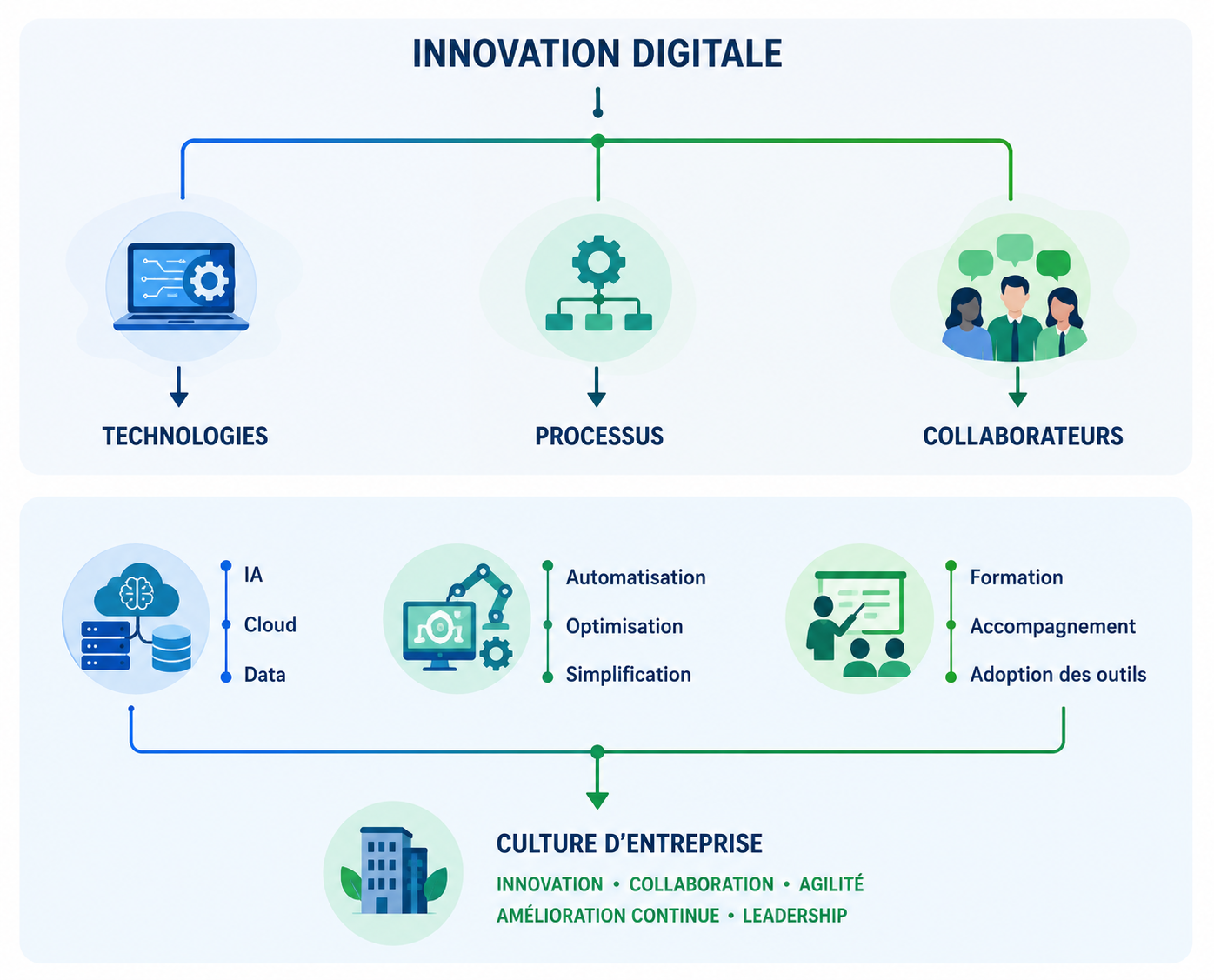
These four dimensions are interdependent. A company may have the best technologies on the market; if employees do not use them or if processes are not adapted, the benefits will remain limited.
1. Technology
Technology is the engine of innovation.
Companies are currently investing in:
- artificial intelligence (AI);
- machine learning ;
- cloud computing ;
- Big Data ;
- the Internet of Things (IoT) ;
- collaborative platforms ;
- low-code/no-code solutions ;
- cybersecurity ;
- robotic process automation (RPA).
However, technology is only a means to an end. To create value, it must address a clearly identified business need and be easily adopted by users.
2. Processes
Digital innovation often leads to rethinking how a company operates.
The main objectives are:
- automating repetitive tasks ;
- streamlining communication between teams ;
- reducing processing times ;
- improving data quality ;
- limiting human error.
By optimizing processes, organizations gain efficiency while strengthening their ability to adapt.
3. Employees
Employees are the primary drivers of innovation.
Even the most powerful technologies yield few results if they are poorly understood or underutilized.
Research from McKinsey shows that companies that combine technology investments with changes to processes, ways of working, and employee skills create more value than those that focus solely on deploying tools.
This is why digital innovation projects are generally accompanied by:
- targeted training;
- regular communication;
- change management;
- contextual support;
- user guidance.
The goal is not just to deploy a solution, but to enable teams to use it effectively in their daily work.
4. Corporate culture
Culture is often the most underestimated factor.
The most innovative companies encourage:
- experimentation;
- collaboration;
- knowledge sharing;
- continuous improvement;
- the freedom to fail.
Analyses published by the MIT Sloan Management Review show that leadership, corporate culture, and skills development are key factors in the success of digital transformations.
A culture that fosters innovation facilitates the adoption of new tools and accelerates transformation projects.
The benefits of digital innovation
When properly deployed and adopted, digital innovation generates benefits at every level of the company.
Improved productivity
Automating repetitive tasks allows employees to dedicate more time to high-value assignments. Processes become faster, errors decrease, and teams become more efficient.
Cost reduction
Digitalization limits manual operations, reduces redundancies, and optimizes resource utilization. Over time, it contributes to improving the organization's profitability.
A better customer experience
Companies can offer faster, more personalized, and more consistent services across all communication channels. Customer journeys become more seamless, which boosts satisfaction and loyalty.
A better employee experience
Intuitive tools, supported by training and assistance programs, simplify the daily work of teams. Employees gain autonomy and adopt new business software more easily.
Faster decision-making
Leveraging data provides decision-makers with reliable indicators to manage their business, anticipate market trends, and identify new opportunities.
A more agile company
Organizations that innovate continuously are better prepared to face technological, economic, or regulatory changes. They can adapt their processes and offerings to new market expectations more quickly.
This ability to adapt is now a major competitive advantage in an environment where innovation cycles are becoming increasingly short.
The main barriers to digital innovation
Despite its many advantages, digital innovation remains a challenge for many organizations. The difficulties encountered are not always related to the technologies themselves, but rather to their integration into daily practices.
The main obstacles are:
- resistance to change;
- a lack of digital skills;
- software that is complex to master;
- outdated information systems;
- a lack of governance;
- poorly defined objectives;
- low employee engagement.
According to a global survey by Gartner, less than half of all digital initiatives fully achieve their set business goals. This figure serves as a reminder that a transformation project is not just about choosing a technological solution: governance, change management, and user adoption are just as critical.
Success factors for digital innovation
Companies that successfully transform generally take a holistic approach, where technology serves the business and its users.
Beyond the tools themselves, success relies on a process of continuous improvement. The highest-performing organizations regularly evaluate usage, gather user feedback, and adapt their support systems over time.
Key digital innovation trends for 2026
Digital innovation is evolving rapidly, driven by new technologies and the growing expectations of businesses. Several trends are expected to continue transforming organizations over the coming years.
Generative artificial intelligence
Having already automated certain tasks, generative AI now helps employees create content, analyze data, draft documents, and support teams in their daily activities.
The challenge for companies is no longer just to experiment with these technologies, but to integrate them securely into their business processes.
AI agents
Intelligent agents will gradually take over entire processes rather than just isolated tasks.
For example, they will be able to analyze a customer request, retrieve information from multiple applications, propose a response, and automatically trigger specific actions.
This evolution paves the way for much more advanced business process automation.
Hyperautomation
Automation now combines several technologies:
- artificial intelligence;
- RPA (Robotic Process Automation);
- document analysis;
- intelligent workflow.
The goal is to automate end-to-end processes while allowing employees to focus on high-value activities.
Low-code and no-code platforms
Business departments are increasingly developing their own applications using low-code and no-code solutions.
This democratization of development accelerates innovation projects while reducing implementation times.
The Digital Workplace
Employees use an increasing number of applications every day.
Companies are now looking to create a unified digital work environment where different tools communicate with each other to simplify the user experience.
Integrated cybersecurity
Digital innovation is accompanied by an increase in cyber risks.
Security is no longer treated as a separate issue but is directly integrated into transformation projects from the design stage ("Security by Design").
Digital adoption as a performance factor
Companies are gradually realizing that software only delivers value if it is actually used.
Digital Adoption Platforms are becoming a strategic lever for accelerating skill development, reducing errors, and improving the return on investment for digital projects.
Why is tool adoption essential?
Investing in an ERP, CRM, HRIS, or collaborative platform often represents a significant financial commitment.
However, the expected benefits are only achieved if employees actually use these tools in their daily activities.
Low adoption can lead to:
- decreased productivity;
- more frequent errors;
- an increase in IT support requests;
- resistance to change;
- limited return on investment.
Digital innovation only creates value when it is supported by a genuine adoption strategy.
Digital Adoption Platforms (DAPs) address this challenge directly. They guide users within their applications using interactive walkthroughs, contextualized training paths, and usage analytics.
They help reduce onboarding time, improve the employee experience, and ensure the success of transformation projects.
How Knowmore supports digital innovation
For over 20 years, Knowmore has been helping companies with their digital transformation projects by putting users at the heart of success.
Its solutions allow you to:
- accelerate the adoption of business software;
- support employees directly within their work environment;
- reduce training costs;
- measure actual application usage;
- identify friction points;
- improve the user experience for the long term.
With its K-Studio, K-Now and K-Valuesolutions, Knowmore helps organizations design interactive support journeys, assist users in real time, and precisely measure digital tool adoption.
Present in over 70 countries and a partner to 40% of CAC 40 companies, Knowmore supports businesses, government agencies, and international organizations in successfully navigating their digital transformation projects.
Because technology only has an impact when it is fully adopted, Knowmore places the user at the heart of every project to turn digital investments into concrete, lasting results.
Conclusion
Digital innovation is not limited to adopting new technologies. It is primarily about sustainably transforming work methods, processes, and services to create greater value for the company and its users.
Organizations that succeed in their transformation are those that combine technological innovation, human support, and continuous improvement. By placing employees at the center of this process, they maximize the adoption of new tools and secure their return on investment.
Looking to accelerate the adoption of your business software and turn your digital transformation projects into a true performance driver? Discover how Knowmore's solutions can support your teams at every stage of their digital journey.
Success stories
How Knowmore redefines digital adoption: inspiring transformation stories where our Solutions help companies master their digital tools and reach new heights.


What are the main drivers of digital innovation?

The main drivers are artificial intelligence, cloud computing, process automation, data analytics, collaborative platforms, low-code/no-code, and digital adoption platforms.
How do you measure the success of digital innovation?
Companies generally rely on several indicators: software adoption rates, productivity gains, user satisfaction, return on investment (ROI), reduction in support tickets, processing times, and usage rates of key features.
What is the link between digital innovation and a digital adoption platform?
A digital adoption platform guides users directly within their applications through interactive walkthroughs, contextual support, and usage analytics. It accelerates the onboarding of new tools, fosters their adoption, and maximizes the benefits of digital transformation projects.