

Digital onboarding: how to ensure employee engagement from day 1
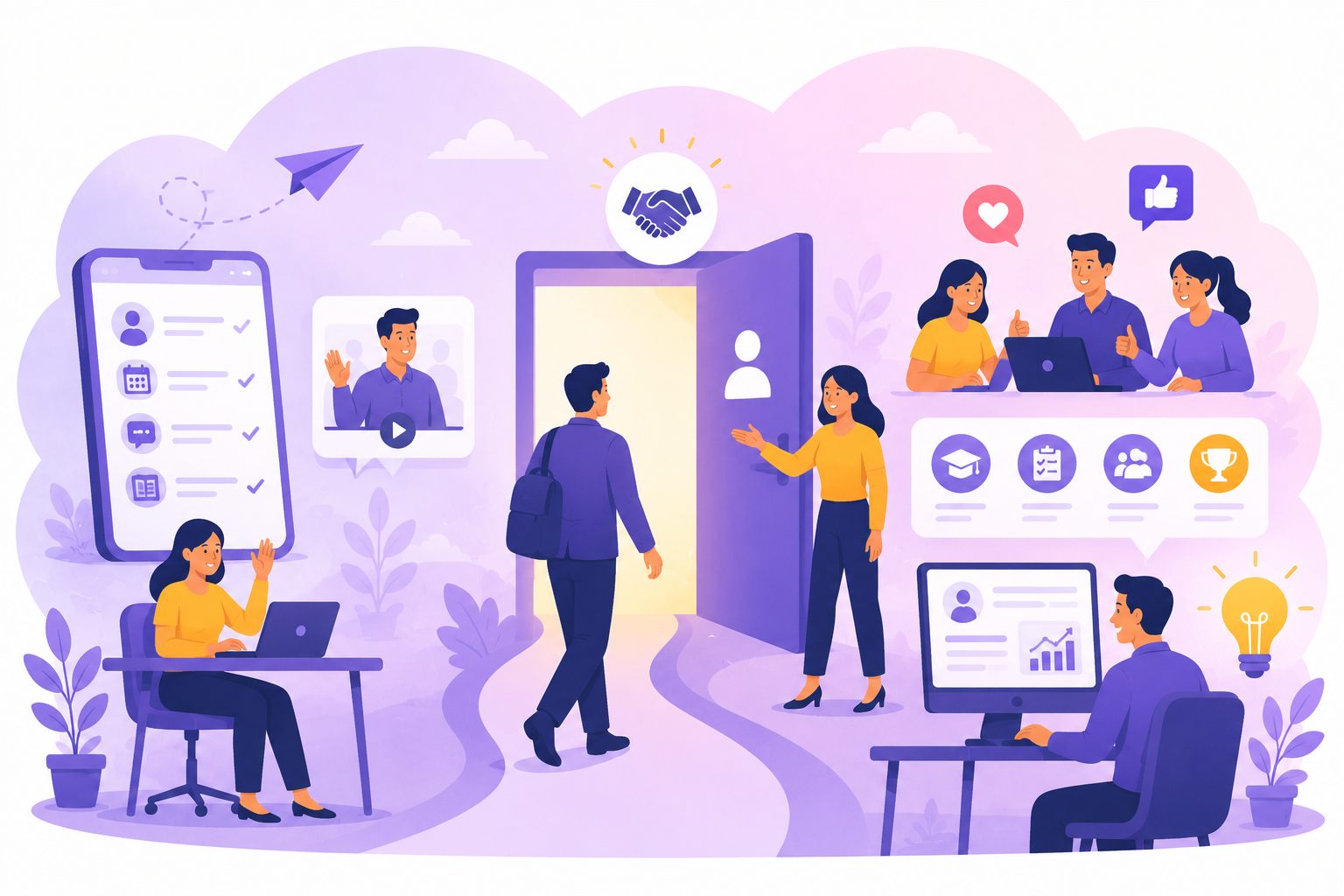
As companies accelerate their digital transformation, employees must quickly master an increasing number of business applications: ERPs, CRMs, HRIS, collaborative tools, and specialized software. Without proper support, this complexity can lead to frustration, wasted time, and disengagement.
Digital onboarding addresses this challenge directly. By combining contextual guidance, immersive training, and adoption tracking, it transforms those first few days into a powerful driver of engagement and performance.
Why is the first day so important?
The first day marks the beginning of the employee experience. It is during this period that the new hire discovers their environment, their tools, and the company's specific processes.
Successful onboarding helps to:
- quickly build a sense of belonging;
- reduce the stress associated with learning new tools;
- accelerate skill development;
- foster autonomy;
- improve talent retention.
Conversely, a poorly prepared integration process can hinder productivity for several weeks and increase the burden on support teams and managers.
The limitations of traditional onboarding
Traditional methods are now showing their limitations.
New hires are often bombarded with a massive amount of information upon arrival: documentation, procedures, video training sessions, or PowerPoint presentations. Much of this content is forgotten just a few days later.
The most common difficulties include:
- cognitive overload during the first few days;
- training that is too far removed from real-world situations;
- materials that quickly become obsolete;
- a lack of support when the user actually needs it.
The result: employees waste time searching for information, make more mistakes, and frequently reach out to IT support or their colleagues.
Digital onboarding: a new user-centric approach
Digital onboarding is not just about digitizing training. It aims to support every employee directly within their work environment.
With a Digital Adoption Platform (DAP), users receive contextual help at the exact moment they are using an application.
This approach offers several advantages:
- interactive guides integrated directly into software;
- assistance available at any time;
- progressive learning tailored to each user's skill level;
- better retention through hands-on practice.
Employees learn by performing their daily tasks rather than by memorizing theoretical documentation.
Focusing on "learning in the flow of work"
New training practices prioritize Learning in the Flow of Work, which means learning that is integrated directly into daily activities.
Instead of interrupting work to attend training, employees receive the right information at the right time.
A platform like K-NOW, Knowmore's digital adoption platform, allows you to offer:
- step-by-step guided tours;
- contextual help bubbles;
- automated reminders;
- targeted notifications for application updates.
This support significantly reduces the time required to master a new tool while improving the user experience.
Discover the K-NOW
Risk-free training through simulations
Some business applications require complex operations or carry risks if errors occur.
This is particularly true for ERPs, CRMs, financial software, or industrial applications.
Simulated environments allow new employees to practice under realistic conditions without impacting production data.
With K-STUDIO, companies create interactive simulations that faithfully replicate their business applications.
The benefits are numerous:
- learning by doing;
- reduced stress during initial use;
- improved user confidence;
- fewer operational errors.
This immersive approach significantly accelerates the skill-building process.
Measuring engagement to improve onboarding
Effective onboarding must be driven by objective metrics.
HR managers and transformation teams need to know:
- which paths are actually being used;
- which features remain unknown;
- where difficulties arise;
- how much time is needed to reach autonomy.
Analytics tools make it possible to precisely identify friction points in order to continuously improve integration paths.
With K-VALUE, companies have access to adoption, engagement, and performance metrics that allow them to measure the impact of training and support initiatives.
Discover K-VALUE
Artificial intelligence enhances the onboarding experience
The rise of generative AI opens up new possibilities for digital onboarding.
Employees can now access the right information more easily thanks to:
- conversational assistants;
- personalized recommendations;
- intelligent knowledge base search;
- journeys tailored to each user's profile.
When combined with a Digital Employee Experience (DEX) strategy, AI helps streamline onboarding without replacing human support.
The goal remains to provide relevant assistance exactly when it adds the most value.
Best practices for successful digital onboarding
Top-performing companies share several key characteristics.
First, they design simple, progressive journeys tailored to each employee's role. They also prioritize hands-on learning over top-down training.
Support is integrated directly into the applications used daily, which minimizes disruptions in the user journey.
Finally, they regularly measure adoption metrics to continuously improve the experience provided.
This approach not only helps strengthen employee engagement but also improves the organization's overall performance.
Digital onboarding: a strategic investment
Today, onboarding goes far beyond the initial welcome phase for new hires. It is a strategic lever for accelerating the adoption of digital tools, strengthening engagement, and sustainably improving the Digital Employee Experience.
By combining contextual guidance, immersive training, and adoption measurement, companies reduce time-to-competency while offering a smoother experience for their employees.
In a context where digital transformations are accelerating and applications are constantly evolving, investing in effective digital onboarding is no longer just a competitive advantage: it is an essential requirement for ensuring the long-term adoption of business tools, improving digital well-being, and maximizing the return on investment for transformation projects.
Knowmore supports organizations in this process through a complete ecosystem consisting of K-NOW for contextual guidance, K-STUDIO for immersive training, and K-VALUE to measure results and continuously optimize the user experience.