

10 HRIS software solutions to support HR digitization in 2026
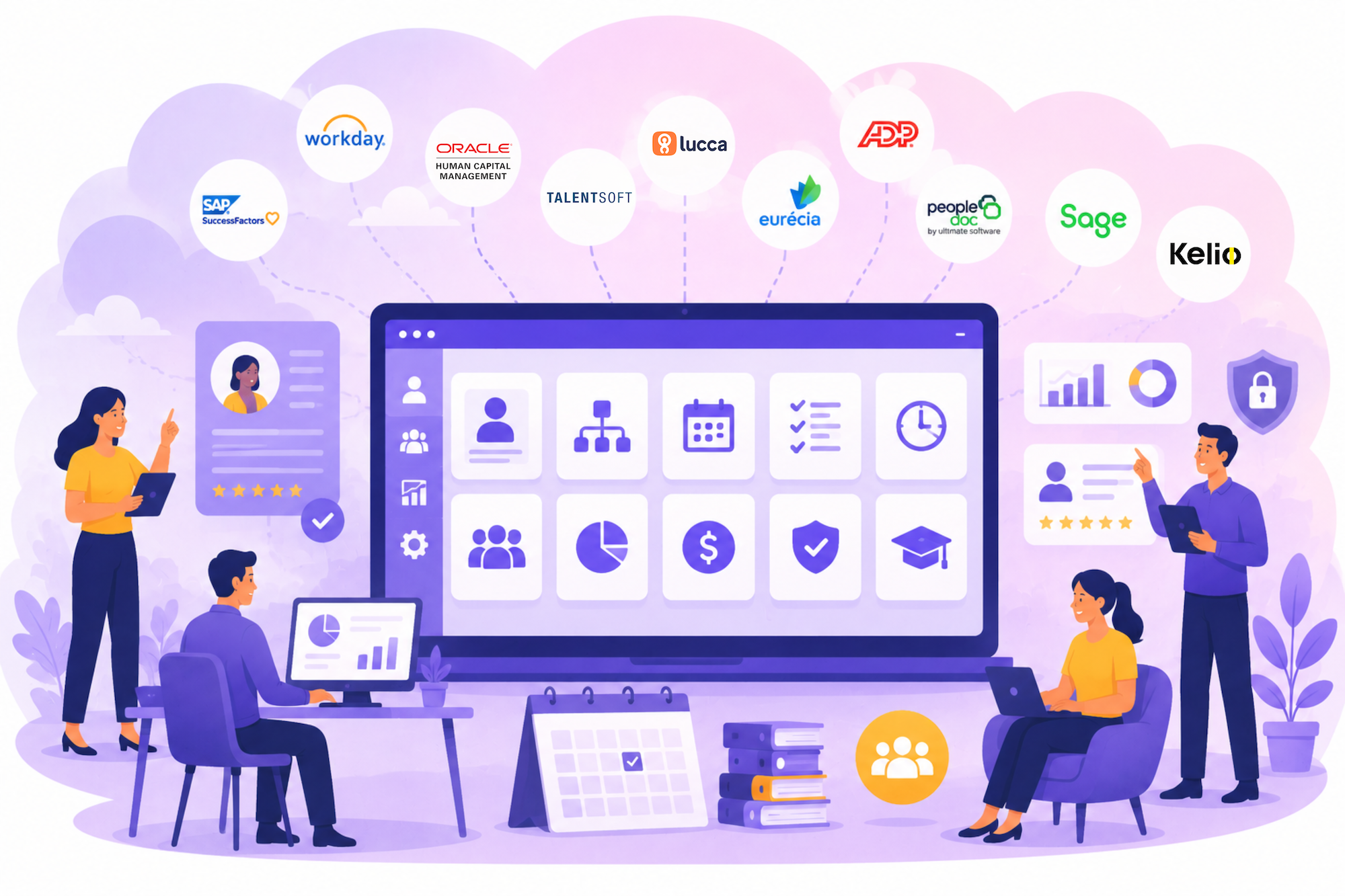
The Human Resources Information System (HRIS) addresses these challenges by centralizing HR data, automating processes, and facilitating team collaboration. The latest solutions go even further by integrating artificial intelligence, advanced analytical features, and tools that enhance the employee experience.
But with an increasingly crowded market, how do you choose the software best suited to your organization? Discover our comparison of the 10 most effective HRIS software solutions in 2026, the essential criteria for making the right choice, and best practices for a successful HR digitization project.
What is HRIS software?
A Human Resources Information System (HRIS) is a platform that centralizes all of a company's HR processes within a single tool.
It allows you to manage:
- employee records;
- recruitment;
- onboarding;
- time and attendance tracking;
- payroll;
- annual performance reviews;
- training;
- skills management;
- talent management;
- HR reporting.
Unlike simple payroll software or leave management applications, an HRIS provides a comprehensive view of the employee lifecycle. Most solutions are now available as SaaS, making them easy to deploy and integrate with other applications such as ERPs, CRMs, or LMSs.
Why digitize your HR function with an HRIS?
Investing in an HRIS is not just about replacing Excel files or digitizing documents. It is about optimizing HR processes to increase efficiency and improve the employee experience.
The main benefits are numerous:
- automating repetitive administrative tasks;
- centralizing HR data in a single database;
- reducing the risk of errors and duplicate entries;
- improving regulatory compliance;
- streamlining communication between employees and HR teams;
- facilitating decision-making with dashboards;
- enhancing the employee experience through self-service portals.
Ultimately, HR teams spend less time on administrative tasks and more on high-value missions such as skills development, employee engagement, or talent management.
How do you choose your HRIS software?
The best HRIS software is, above all, the one that meets your organization's needs.
Before comparing solutions, several criteria must be analyzed:
- the size of your company;
- functional coverage (payroll, recruitment, training, talent management, time and attendance, etc.);
- ease of use;
- integration capabilities with your information system;
- artificial intelligence features;
- workflow customization;
- GDPR compliance;
- reporting and analytics capabilities;
- quality of support and guidance.
It is also essential to anticipate change management. A high-performance tool will only deliver results if it is adopted sustainably by users.
Comparison table of the main HRIS software
The 10 best HRIS software
1. Workday
Workday is one of the most comprehensive HRIS platforms on the market. Primarily aimed at large enterprises, it covers the entire employee lifecycle: recruitment, talent management, compensation, training, workforce planning, and advanced analytics.
Strengths:
- high-performance cloud platform;
- integrated artificial intelligence;
- advanced reporting;
- strong customization capacity.
2. SAP SuccessFactors
SAP SuccessFactors supports companies in the comprehensive management of their human resources. Its native integration with the SAP ecosystem makes it a solution particularly well-suited for organizations already using this environment.
The platform covers:
- Core HR;
- recruitment;
- onboarding;
- performance management;
- training;
- compensation.
3. Oracle Fusion Cloud HCM
Oracle Fusion Cloud HCM is designed for large organizations looking to automate their HR processes.
The solution includes:
- generative AI;
- predictive analytics;
- skills management;
- recruitment;
- internal mobility;
- workforce planning.
4. Lucca
Developed in France, Lucca appeals to many SMEs and mid-market companies thanks to its intuitive interface and modular approach.
Its main modules cover:
- leave management;
- expense reports;
- working hours;
- performance reviews;
- employee files.
Its simple deployment makes it easy to adopt.
5. Cegid HR
Cegid offers a comprehensive HR suite tailored to French companies.
It covers, in particular:
- payroll;
- personnel administration;
- recruitment;
- training;
- talent management;
- HR dashboards.
Its regulatory expertise is a major asset.
6. ADP
ADP is a global benchmark in payroll and human resources management.
The platform also allows you to manage:
- absences;
- working hours;
- talent;
- performance;
- international regulatory requirements.
7. Factorial
Factorial is particularly popular with SMEs looking to quickly digitize their HR management.
The solution includes:
- leave management;
- time tracking;
- digital document storage;
- recruitment;
- performance reviews;
- electronic signatures.
Its modern interface ensures a quick learning curve.
8. UKG
UKG is recognized for its expertise in workforce and scheduling management.
The platform is particularly well-suited to the needs of multi-site companies, especially in the manufacturing, retail, and healthcare sectors.
9. Silae RH Suite
Long known for its payroll solution, Silae now offers a comprehensive HR suite for managing employee records, performance reviews, leave, and administrative workflows.
Its native integration with payroll simplifies day-to-day management.
10. BambooHR
BambooHR is an intuitive solution designed primarily for SMEs.
It streamlines:
- recruitment;
- onboarding new employees;
- performance tracking;
- document management;
- HR reporting.
Its simplicity is its main advantage.
HRIS software trends in 2026
HRIS platforms are evolving rapidly to meet new business challenges.
The main trends observed are:
- the integration of generative AI to assist HR teams;
- advanced automation of administrative processes;
- the development of HR copilots;
- increased personalization of employee journeys;
- the rise of predictive analytics to anticipate skills needs;
- better integration with Microsoft 365, Teams, Slack, and ERPs;
- the growing importance of Digital Employee Experience (DEX) as a strategic indicator.
Companies are no longer just looking to digitize their processes, but also to improve the digital well-being and productivity of their employees.
Why is HRIS adoption the true key to success?
Choosing high-performance software is just the first step. The success of an HRIS project depends primarily on user adoption.
When a new tool is deployed, employees may encounter several difficulties:
- lack of knowledge regarding features;
- data entry errors;
- resistance to change;
- increased support requests;
- low usage of advanced features.
To mitigate these obstacles, it is recommended to implement a comprehensive support strategy.
A Digital Adoption Platform (DAP) allows for the integration of interactive guides, contextual help, and personalized workflows directly into the HRIS. Users are guided as they perform their tasks, without ever leaving their work environment.
This is precisely the goal of K-NOW, Knowmore's digital adoption platform, which simplifies the onboarding process for business applications and enhances the user experience.
To further strengthen skill development, K-STUDIO allows for the creation of interactive simulations that faithfully replicate HR applications. Employees can practice in a safe environment before using the software in real-world conditions.
Finally, K-VALUE helps HR managers and transformation teams measure application adoption, identify friction points, and evaluate the ROI of training and change management initiatives.
By combining a high-performance HRIS with tools dedicated to digital adoption, companies maximize the benefits of their HR transformation while sustainably improving the Digital Employee Experience.
Conclusion
Choosing an HRIS is a strategic decision that has a lasting impact on human resources management. Solutions such as Workday, SAP SuccessFactors, Oracle Fusion Cloud HCM, Lucca, Cegid HR, ADP, Factorial, UKG, Silae RH Suite, or BambooHR enable the digitization of HR processes, the automation of administrative tasks, and the improvement of the employee experience.
However, an HRIS project is about more than just choosing a platform. Its success also depends on the employees' ability to embrace new tools. Combining an HRIS with a digital adoption strategy, immersive training, and performance metrics helps secure deployment, accelerate skill development, and sustainably improve HR performance.