Software adoption in business applications rarely fails for technical reasons. It fails because users are left on their own after go-live: one-off training is quickly forgotten, help is missing at the moment of use, and nobody measures real usage. Unused features, errors and workarounds follow. Continuous digital support (training, in-app guidance and usage analytics) closes that gap.
Key takeaways
- A deployed business application is not an adopted one: adoption is won or lost after go-live.
- One-off training cannot keep up with numerous applications that change with every release.
- Without support, users work around the tool: shadow IT, more support tickets and an uncertain return on investment.
- Effective digital support combines training, contextual guidance inside the application and measurement of real usage.
1. Deploying business software vs. adopting business software
A successful deployment does not guarantee successful adoption. The IT departments or project teams may declare an application "in production" after the testing and go-live phases, but that's the beginning of the real transformation.
Related use case: custom software adoption
The gap between intended and actual use
Without support:
- Users only leverage a fraction of the features.
- Operational errors multiply.
- The learning curve is long and non-linear.
- Theuser experience deteriorates.
- The promise of efficiency gets lost in daily frictions.
How can you tell a business application is poorly adopted?
A business application (ERP, CRM, HRIS, CMMS, PLM) is adopted when its users rely on it regularly, for the right processes and with sufficient quality. The number of active licenses says little about adoption. Watch for these warning signs:
- Shallow usage: basic screens are used, high-value features are ignored.
- Workarounds: parallel spreadsheets, month-end batch entry, requests sent by email.
- Recurring data-entry errors: incomplete records and manual rework downstream.
- Overloaded support: the same "how do I...?" questions come back after every update.
- Gaps between teams: one site or department uses the tool, another avoids it.
The context makes these symptoms worse. In a Gartner survey of 4,861 employees conducted in late 2022, 47% of digital workers said they struggle to find the information or data they need to do their jobs, and knowledge workers used an average of 11 applications. To confirm these signals, rely on software adoption KPIs measured in the tool rather than on impressions.
2. Why traditional training is no longer enough
Traditional training models (in-person, e-learning, PDF tutorials) have a limited impact in a complex and changing business environment:
- Tools evolve rapidly (updates, new modules).
- Users forget what they've learned after a few days.
- Training materials are often disconnected from the real-world usage context.
What's missing: continuous training integrated into the tool, in a real-world situation.
How digital guidance fundamentally changes things
Good digital guidance transforms the user experience. It's no longer just about “learning to use a tool” but being guided in the moment, in real-time, without leaving their work environment.
Let's take a concrete example. An employee needs to enter a purchase request into an ERP. They haven't done it for several months. They hesitate, click randomly, or ask a colleague. With digital guidance integrated into the interface, like that offered by K-NOW, a contextual guide directs them step-by-step, according to their profile, context, and the task at hand. They proceed confidently, without burdening the support team.
The Knowmore approach: train, guide, measure
Digital support isn't just about guidance. It's built on a complete ecosystem, designed to support every stage of the adoption cycle:
Train with immersive, risk-free environments. Thanks to K-STUDIO, users can practice in realistic simulations of their business tools. We don't explain an abstract process to them: they experience it, they repeat it, they correct themselves. The result: rapid, concrete, effective skill development.
Guide in real-world usage, directly within the application. This is the role of K-NOW, Knowmore's DAP (Digital Adoption Platform), which embeds an intelligent layer into the interface. It adapts assistance to contexts, profiles, and usage. It becomes a silent co-pilot, present at just the right moment.
Measure adoption factually. With K-VALUE, decision-makers no longer rely on estimates or gut feelings. They have precise data: which modules are used, by whom, how often, and with what success rate. They identify friction points, drive change, and continuously optimize the user experience.
4. Without support, risks accumulate
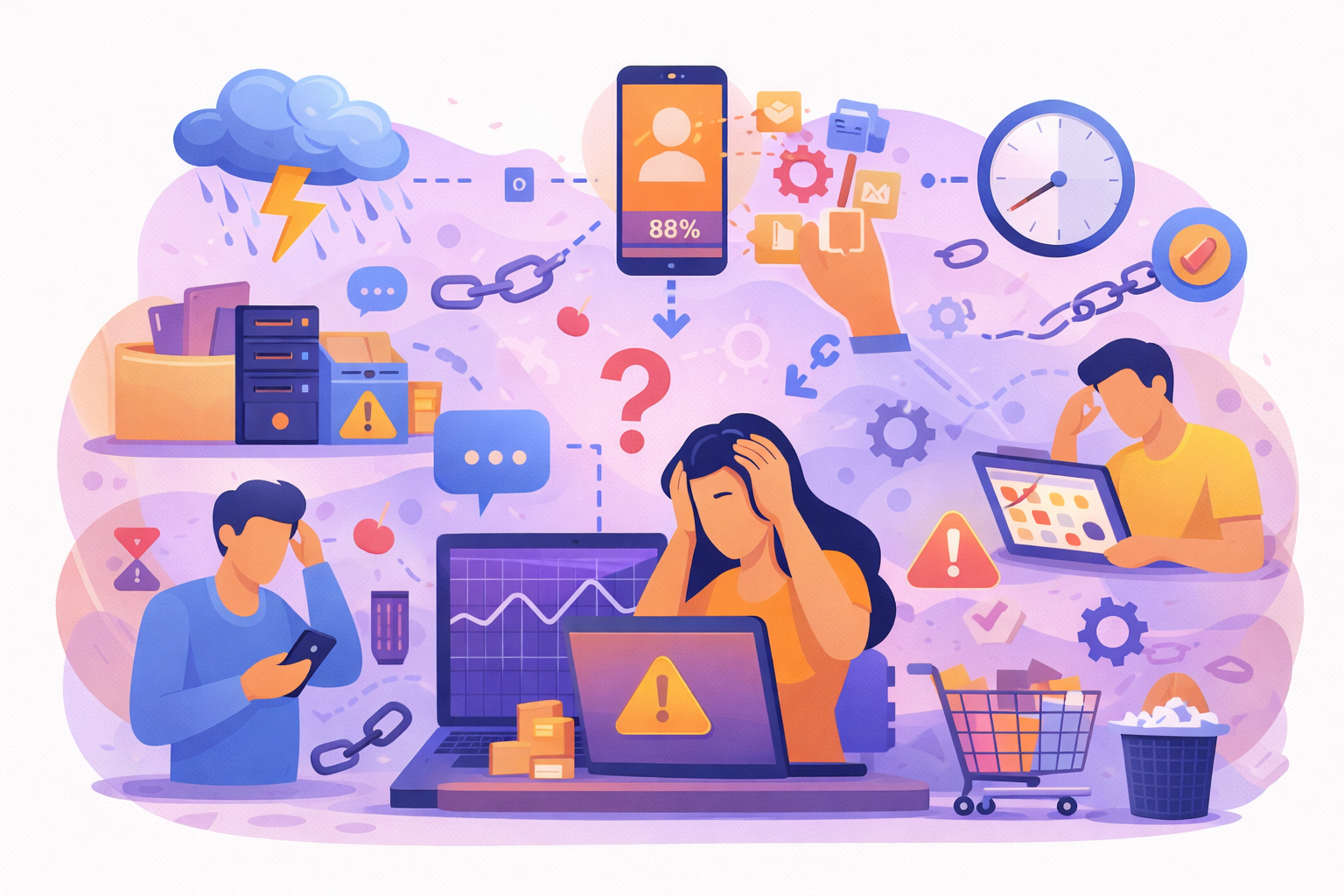
The absence of structured digital support triggers a series of domino effects. First, the user gets lost. Then, they find workarounds. Finally, they reject it. Very quickly, the tool becomes an irritant rather than a performance driver.
This concretely results in:
- A massive return to parallel practices (shadow IT)
- A surge in support tickets
- Repetitive training on the same topics
- Software investments with uncertain ROI
- A negative perception of digital transformation
And often, a gradual disengagement of teams from change.
Conversely, well-designed and tool-supported guidance transforms adoption into a performance driver:
- Users feel guided and supported in their tasks.
- Time to proficiency is significantly reduced.
- Operational errors decrease.
- Support is streamlined.
- Return on investment is measurable and justifiable.
- The tool becomes an ally, not a constraint.
Should you replace a poorly adopted business application?
When an application is barely used, the temptation is to replace it. A replacement is expensive, though, and if the real cause is a lack of support, the new tool will run into the same problems. Before deciding, separate the two situations:
| Replacement is justified if... | Better support is enough if... |
|---|---|
| The vendor no longer supports the version, or the technology is obsolete | The tool covers the needs but users cannot find the features |
| Business processes have changed and the tool no longer covers them | Errors come from poorly understood data-entry rules |
| Maintenance and custom development costs keep rising | Difficulties are concentrated on a few screens or user groups |
| Integration with the rest of the information system is no longer possible | Support tickets are mostly "how do I...?" questions |
Either way, start with a diagnosis based on usage data: which journeys are abandoned, where errors cluster, which teams are disengaging. If you do replace the application, plan user support from the scoping phase and roll out in stages so you can manage the IT project without disrupting operations.
5. Digital support vs. human support
Digital doesn't replace humans; it augments them. With an adoption platform like K-NOW, an HR trainer or a PO can:
- Create personalized, no-code guided journeys
- Target messages to specific profiles
- Track actual user progress
- Adapt actions based on concrete data
Digital support becomes an extension of project management, with a granularity and scalability that are hard to achieve otherwise.
Conclusion: adoption means integration, not just training
In a constantly evolving digital environment, adopting a business application can no longer rely solely on initial training or user initiative. It requires support designed from the project's inception, integrated into the tools, data-driven, and aligned with business needs.
This is precisely what Knowmore solutions offer. They enable organizations to make their applications smart, adaptive, evolving — and most importantly, truly adopted.
Are you preparing for an application deployment or noticing a lack of usage?
Discover our solutions or book a demo to see how to integrate tailored digital support into your existing tools.
Frequently asked questions
What is software adoption?
Software adoption is the point at which employees use a new application regularly, correctly and for the processes it was bought for, so that it delivers the expected value. It goes beyond deployment, which only makes the software available. Adoption is measured through active usage, feature depth, task completion and error rates after go-live.
What is a business application?
A business application is software built to support the specific processes of a function or industry: ERP for integrated management, CRM for customer relationships, HRIS for human resources, CMMS for maintenance or PLM for product lifecycle management. Unlike general office tools, a business application carries its own business logic and rules, which is why it needs role-specific training.
What is a digital adoption platform (DAP)?
A digital adoption platform (DAP) is a software layer that runs on top of a business application to guide users step by step with tooltips, interactive walkthroughs and messages targeted by role. It also measures how the application is really used. A DAP complements training by providing help at the exact moment a user needs it.
Who is responsible for software adoption in a company?
Software adoption is a shared responsibility. The business sponsor sets usage goals, the IT department provides a reliable and measurable tool, the project lead or digital adoption manager runs user support, and key users relay it on the ground. Without a clearly named owner after go-live, software adoption tends to decline.
How long does software adoption take after go-live?
Software adoption takes well beyond go-live, and its length depends on the application's complexity, how often it is used and how far it departs from old habits. A hypercare period handles the first incidents; support must then follow each new release and each new hire. Set measurable usage targets rather than an end date.