The CIO role has shifted from running IT infrastructure to co-leading digital transformation. The chief information officer and the IT department align technology with business strategy, secure data, and integrate tools such as ERP and HRIS. Increasingly, they also share responsibility with HR for change management, so that new tools are actually adopted by employees.
Key takeaways
- The CIO and the IT department no longer just maintain infrastructure: they select, integrate and secure the tools that serve company strategy.
- HR projects such as an HRIS rollout succeed when IT and HR work as a team from the scoping stage.
- Change management is a shared mission between HR, managers and IT: roadmap, pilots, training and adoption measurement.
- Gartner found that only 48% of digital initiatives meet or exceed their business outcome targets, rising to 71% when CIOs and business leaders co-own delivery.
Introduction: The IT Department, much more than a technical service
Long perceived as a technical support function, the IT department, led by the chief information officer (CIO), is now at the heart of companies' strategic considerations. With the acceleration of digital transformation, the IT Department no longer merely maintains infrastructure: it drives, guides, and embodies innovation.
But to fully play this role, it must undergo a profound transformation, by integrating new methods, collaborating with other key functions – especially the Human Resources (HR) – and by placing people at the heart of its projects.
What does a CIO do? Key responsibilities of the IT department
The CIO's responsibilities cover both running the information system day to day and transforming it:
- Set the IT strategy in line with business goals, with a roadmap and clear trade-offs between projects.
- Keep systems running and secure: infrastructure, applications, networks, cloud services and data.
- Lead digital projects: solution selection, integration, rollout, budget and vendor management.
- Govern data and AI: data quality, privacy compliance and responsible use.
- Support users: service desk, training and measurement of tool adoption.
- Reduce IT's footprint, a growing part of green IT strategies led by the CIO.
To steer all of this, CIOs rely on a dedicated set of IT management tools for portfolio, service and asset management.
The CIO is often confused with the chief technology officer (CTO). As a rule of thumb, the CIO looks inward, at the systems and tools employees use to run the business, while the CTO looks outward, at the technology behind the products and services sold to customers. In many organizations the two roles overlap or are held by the same person.
IT Department and Digital Transformation: An Indispensable Alliance
A Driver of Performance and Agility
Digital transformation cannot succeed without a robust, agile, and scalable IT architecture. This is precisely the IT Department's domain. It is responsible for deploying the right tools (ERP, CRM, HRIS, collaborative platforms) while ensuring their interoperability.
Thanks to the IT department:
- processes are automated,
- data is better utilized,
- teams become more efficient.
However, this requires an evolution of its role: from technical solutions manager, the IT department becomes a strategic partner for business units, particularly in HR digitalization.
An IT department dedicated to employee experience
When IT systems align with HR needs
Today, almost every HR project has a technology dimension. Theemployee experience relies on fluid, intuitive, and connected tools. The IT department enables their implementation through:
- modern, modular HRIS,
- mobile applications for leave management, expense reports, onboarding, etc.
- the integration of HR data into the overall information system.
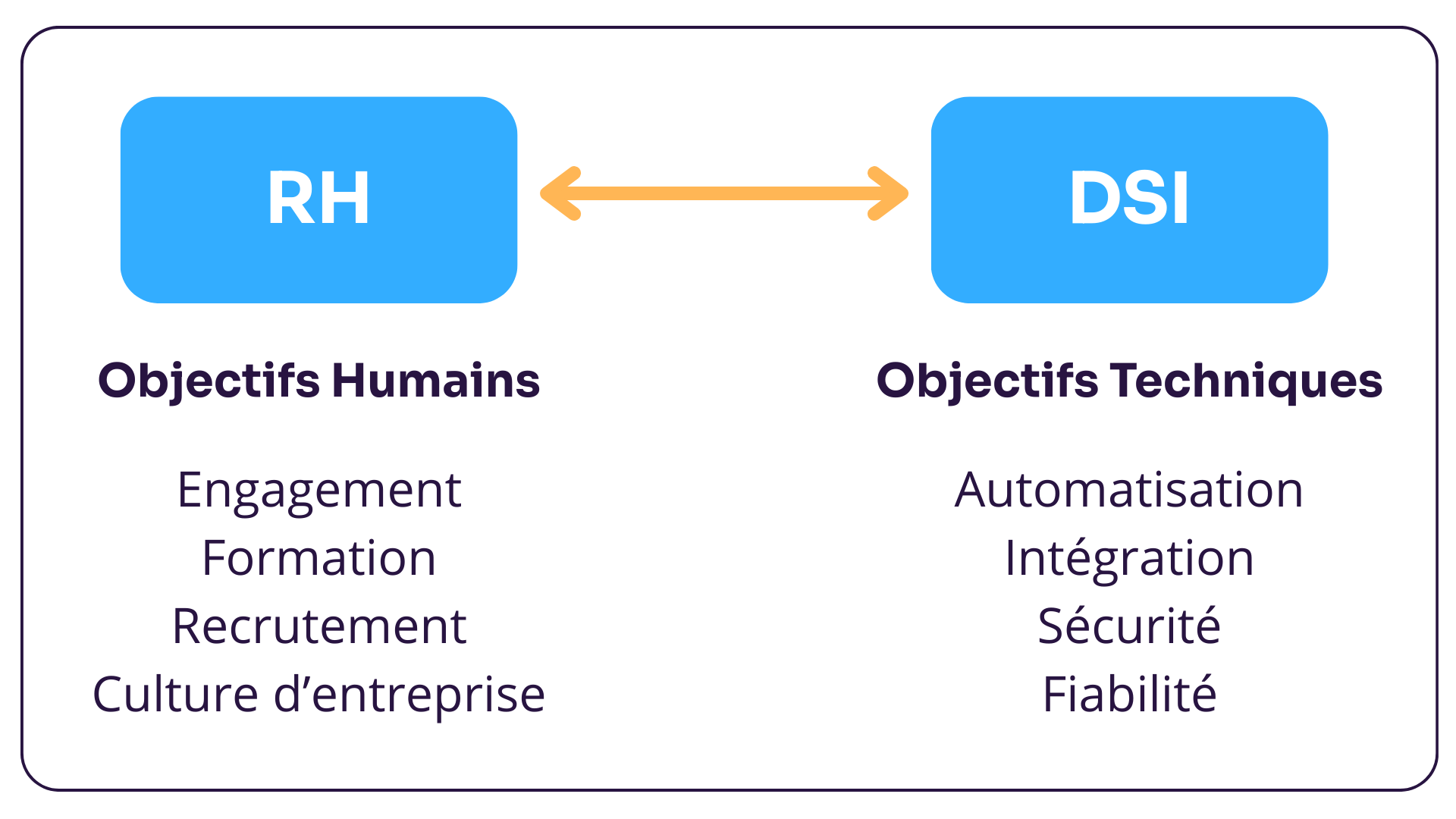
The success of these projects depends on the close collaboration between HR and IT. The IT department provides technical expertise, while HR ensures functional relevance.
Infographic: A Winning HR - IT Synergy
IT Governance and Change Management: A Winning Duo
The Role of the IT Department in Change Management
Implementing any new tool – especially an HRIS or ERP – involves profound changes:
- new work habits,
- process reorganization,
- user support.
Therefore, change management becomes a shared mission between HR, managers, and the IT department. The latter plays a key role by:
- building a clear project roadmap,
- integrating pilot phases and user testing,
- ensuring training and digital adoption.
But note: the human element remains paramount. A solution, no matter how effective, will fail without user adoption.
From Tech to Human: The IT Department's New Approach
Shifting from an executor to a facilitator role
Today, the IT department is expected to adopt a more open, collaborative, and business-oriented approach. This requires:
- a better understanding of business challenges,
- active listening to end users,
- an agile approach to co-creation.
It's no longer just about "deploying a tool," but about transforming a company culture through digital means.
Humanizing Technology
Tools should be designed to:
- simplify daily tasks for employees,
- boost engagement,
- foster autonomy.
The IT department then becomes a function serving human capital.
Major Challenges for Modern IT Departments
1. Cybersecurity and Risk Management
With the increase in sensitive data (HR, finance, R&D, etc.), security becomes a critical issue. The IT department must ensure:
- the protection of personal data,
- system resilience,
- GDPR compliance.
2. Scalability and flexibility
Tools must quickly adapt to business growth or reorganizations, leading to the rise of:
- cloud computing,
- modular and API-first architectures.
3. User experience
UX is no longer a luxury; it's a requirement. Employees want tools as simple as a mobile app. The IT department must therefore:
- integrate design thinking approaches,
- co-create with users,
- measure satisfaction via KPIs.
Use case: A multi-site company's IT department facing a new HRIS
Consider a typical scenario: a company with 1,500 employees across several sites in France. Its HRIS was obsolete, disparate, and not connected with other tools.
The IT department worked in tandem with HR to:
- diagnose needs,
- choose a modern SaaS solution,
- support the change with field ambassadors.
Results:
- faster adoption of the new tool,
- fewer data entry errors,
- time freed up for the HR department.
This kind of success rests on three pillars:
- Shared vision between HR and IT
- User-centric adoption
- Agile change management
How should the CIO and HR lead change management together?
Technology alone rarely delivers the expected results. In its 2025 CIO and Technology Executive Survey, Gartner found that on average only 48% of digital initiatives meet or exceed their business outcome targets, compared with 71% for a small "Digital Vanguard" of CIOs and business executives who co-own digital delivery. On an HRIS, ERP or CRM project, the split of roles between IT and HR is therefore decisive. A five-step approach works well:
- Scope the project together: IT brings architecture, security and integration; HR and business teams bring processes and user needs.
- Analyze the impacts for each population: what changes in tools, tasks and organization.
- Test with a pilot and a network of field ambassadors before the wider rollout.
- Train at the right time: short sessions before go-live, then contextual help inside the application.
- Measure and adjust: usage rates, abandoned journeys, support tickets.
This sequence follows the logic of individual change models such as Prosci's ADKAR (Awareness, Desire, Knowledge, Ability, Reinforcement): explain why, build the desire to change, teach, enable, then reinforce.
What future for IT departments?
Hybrid Skills
Tomorrow's CIOs will need to combine:
- technical skills (cloud, cybersecurity, data),
- soft skills (listening, empathy, leadership),
- strategic vision (business alignment, innovation).
A Seat on the Executive Committee
In many large organizations, the CIO now sits on the executive committee. Why? Because strategic decisions involve a technological component. Integrated IT governance becomes a key factor for resilience and competitiveness.
Conclusion: The IT Department as a Transformation Catalyst
The IT department is now a driver of innovation, agility, and engagement. It is no longer limited to network or license management; it embodies digital transformation in all its complexity – technological, organizational, and human.
To succeed, the IT department must:
- collaborate closely with business units, especially HR,
- involve users in the process,
- leverage change management methodologies that are effective.
At Knowmore, we support IT departments in their digital transformation and adoption projects, with a human-centric approach.
Are you planning an HRIS overhaul, an ERP rollout or an HR innovation initiative?
Explore our solutions for successful and sustainable change management.
Frequently asked questions
What does a CIO do?
A chief information officer (CIO) is the executive responsible for an organization's information systems. The CIO aligns technology with business strategy, manages the IT budget and vendors, keeps infrastructure and applications running and secure, leads digital transformation projects and, increasingly, makes sure employees actually adopt the tools the IT department deploys.
What is the difference between a CIO and a CTO?
The CIO focuses on internal information systems: the applications, infrastructure and data employees use to run the business. The CTO focuses on the technology behind the company's products and services, often with an engineering and innovation remit. In software companies the CTO role is usually prominent, while in large non-tech organizations the CIO typically leads digital transformation.
What is the role of the IT department in digital transformation?
The IT department designs the technical architecture of digital transformation: it selects and integrates tools such as ERP, CRM and HRIS, secures data and keeps systems interoperable. It also shares change management with HR and managers, through pilots, training and adoption measurement. Read our guide to IT governance for the decision-making side.
How can IT and HR work together on an HRIS project?
IT and HR should share the governance of an HRIS project: HR defines processes and needs, while IT guarantees integration with the information system, personal data security and interface quality. After go-live, they should track actual usage together, because an HRIS is rarely used to its full potential without ongoing support.
Why do IT projects fail without change management?
An IT project fails without change management because a delivered tool does not change work habits on its own. Without communication, training and ongoing support, users work around the new system, make more errors or return to old spreadsheets. The expected value is never reached, even when the solution is technically sound. See why digital projects fail.