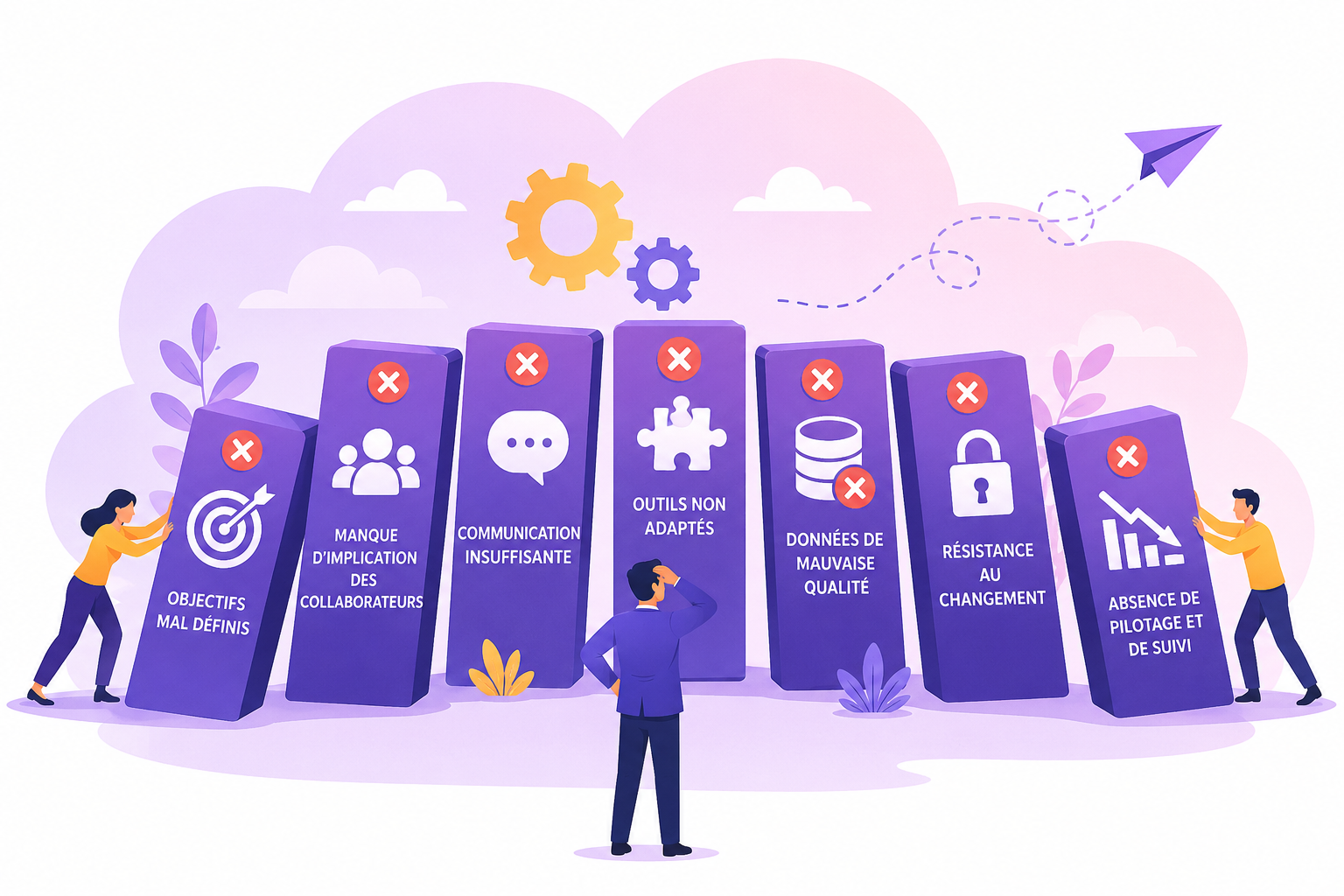
The most common digital transformation mistakes are human rather than technical: treating the project as a pure technology rollout, neglecting change management, limiting training to a few sessions, involving users too late, leaving them alone in the tools, never measuring adoption and stopping support right after go-live. Each of these pitfalls can be anticipated from the scoping phase.
Key takeaways
- According to Boston Consulting Group, 70% of digital transformations fall short of their objectives, mostly for human and organizational reasons.
- The 7 most common mistakes concern the project vision, change management, training, user involvement, in-app guidance, adoption measurement and post-deployment support.
- Go-live is not the finish line: the first months after launch determine whether new tools are adopted for good.
- Measuring adoption lets you correct course before workarounds become habits.
Digital Transformation: Primarily a Human Challenge
Digital transformation has become a strategic imperative for all organizations. Whether it's deploying a new ERP, CRM, HRIS, or integrating artificial intelligence tools, companies are investing heavily in their digital projects.
However, according to Boston Consulting Group research published in 2020, 70% of digital transformation projects fail to achieve their set objectives. The reasons are rarely related to the technology itself. In most cases, failure stems from a lack of adoption, insufficient change management, or too little attention to user experience.
Here are the 7 most common mistakes that jeopardize the success of a digital transformation project.
1. Viewing digital transformation as solely a technology project
One of the most common mistakes is to believe that success primarily depends on choosing the right technological solution.
A new tool, however powerful, creates no value if it's not adopted by users. Digital transformation is above all a human and organizational transformation.
Employees need to understand:
- Why the change is necessary
- What benefits they will gain from it
- How to effectively use the new tools
Companies that place user experience at the heart of their strategy generally achieve better results in terms of adoption and performance.
2. Neglecting change management
Resistance to change remains a major factor in failure.
When users encounter a new application without preparation, they often develop workarounds. Some continue to use their old methods, while others heavily rely on IT support.
An effective change management strategy should include:
- Regular communication
- Business ambassadors
- Tailored training
- Continuous support after deployment
The goal is to create a reassuring environment that fosters employee engagement.
3. Underestimating the importance of training
Many organizations limit training to a few sessions organized before going live.
This approach no longer aligns with current practices.
Employees need continuous support, directly within their work environment. They should be able to learn when they need to.
Today, simulation and immersive learning solutions make it possible to replicate business applications in a secure environment.
With tools like K-STUDIO, users can practice realistic scenarios without risk of error, thereby accelerating their skill development and autonomy.
4. Failing to involve users from the start of the project
Projects driven solely by IT teams or business departments often encounter difficulties during deployment.
End-users are the primary stakeholders affected by changes. Yet, they are sometimes consulted too late.
Involving employees from the outset helps to:
- Identify real needs
- Detect operational pain points
- Foster project buy-in
- Reduce resistance
On-the-ground feedback is a valuable source for continuous improvement and contributes to a better user experience.
5. Leaving users without guidance in their business tools
Even after successful training, users may encounter difficulties when using the application in their real-world context.
Procedures evolve, interfaces change, and users forget certain steps.
Without contextualized assistance, there is a risk of:
- Data entry errors
- Reduced productivity
- An increase in support tickets
- User frustration
Digital adoption platforms enable employees to receive support directly within their applications.
With a solution like K-NOW, users benefit from contextual guidance, targeted notifications, and accessible help exactly when they need it.
This approach promotes "Learning in the Flow of Work," now considered a best practice in digital transformation.
6. Failing to measure new tool adoption
Many companies track adherence to deadlines and budget, but forget to measure a crucial indicator: adoption.
How do you know if the project is truly a success?
The following questions often remain unanswered:
- Are users actually using the key features?
- Which departments or roles encounter the most difficulties?
- Are the training programs producing the expected results?
- Is support demand decreasing over time?
Without reliable indicators, it becomes difficult to adjust support actions.
Analytical solutions like K-VALUE enable objective measurement of digital adoption, user engagement, and the impact of training or change management initiatives.
This data-driven approach helps decision-makers manage their transformation more effectively.
7. Forgetting the employee experience after deployment
Many projects consider going live as the finish line.
In reality, it's often the true starting point.
The first few months following launch are crucial for the sustainable adoption of new tools.
The most successful companies implement an enhanced support phase called "hypercare." This period allows for:
- Quickly identifying difficulties
- Answering user questions
- Adjusting training paths
- Optimizing business processes
This approach directly contributes to improving the Digital Employee Experience (DEX) and the digital well-being of employees.
What do these mistakes look like in ERP, CRM and HRIS projects?
The same mistakes take different forms depending on the system you deploy:
- ERP: processes configured without key users lead to cluttered screens and double data entry; finance or supply chain teams then rebuild their spreadsheets alongside the system. See how to deploy an ERP without burdening operations.
- CRM: if sales reps see no direct benefit, they enter the bare minimum, data becomes incomplete and dashboards lose their reliability. Support has to start from their daily tasks, not from the feature list. See our guide to CRM onboarding.
- HRIS: employees and managers often open the HR portal only a few times a year (reviews, time off, campaigns); without help at the moment of use, every campaign triggers a spike in requests to HR. See the keys to successful HRIS adoption.
In all three cases the symptom is the same: the system works technically but is not used as intended. That is why adoption must be managed as a project objective, alongside deadlines and budget, with indicators tracked by department and site.
How to achieve a successful digital transformation?
Successful digital transformation projects share several common characteristics:
- A clear vision of business objectives
- Strong user involvement
- A structured change management strategy
- Continuous tool support
- Immersive and contextualized training
- Regular adoption measurement
- Constant attention to the employee experience
Technology is merely a lever. True success lies in the organization's ability to evolve usage patterns and create value for users.
How to avoid these 7 mistakes: a phase-by-phase checklist
| Phase | Mistakes to avoid | Best practices |
|---|---|---|
| Scoping | Technology-only project; users consulted too late | Business and adoption objectives with target numbers; a panel of key users involved in decisions |
| Design and preparation | Change management neglected; training limited to a few sessions | Communication plan, change champions, hands-on training on real cases |
| Go-live | Users left alone with the tool | In-app contextual help, local support, up-to-date FAQ |
| After deployment | Adoption not measured; support stopped too early | Hypercare, usage tracking by department, adjustment of content and processes |
Assign an owner to each line of the checklist and review it at every steering committee. This checklist fits into a structured digital adoption plan. To diagnose a project already in production, start from usage: which key features are actually used, by which teams, and at which step do users drop off? The answers usually show up in digital adoption data long before they appear in satisfaction surveys.
Conclusion
Digital transformation is not just about deploying a new solution. It involves rethinking practices, skills, and the digital experience of employees.
Companies that avoid these 7 mistakes greatly improve their chances of success. They promote faster tool adoption, reduce resistance to change, and maximize the return on investment of their projects.
From this perspective, digital adoption platforms, immersive training tools, and adoption measurement solutions become essential allies for building a sustainable and human-centric transformation.
By combining contextualized support, skill development, and data-driven management, organizations can make their digital transformation a true driver of performance and digital well-being.
Frequently asked questions
What is the biggest mistake in digital transformation?
The biggest digital transformation mistake is treating the initiative as a technology project. Companies select and deploy a tool, then assume employees will use it. Without clear business goals, change management and ongoing support, the new system is underused or bypassed, and the expected gains never materialize. Technology enables a transformation; people and processes deliver it.
Why do so many digital transformation projects fail?
Most digital transformation projects fall short for human and organizational reasons rather than technical ones: weak leadership commitment, insufficient change management, unclear objectives and no tracking of results. Boston Consulting Group estimates that 70% of digital transformations miss their objectives. A capable tool that few people use cannot deliver the expected gains, which is why adoption has to be managed and measured.
What are the 3 pillars of digital transformation?
Digital transformation is usually described as resting on three pillars: people (skills, culture, buy-in), processes (redesigned ways of working) and technology (tools, data, infrastructure). A transformation succeeds when all three move together. The costliest mistakes happen when technology advances on its own, without processes being redesigned or employees being supported as their daily work changes.
How long should a hypercare phase last?
A hypercare phase lasts from a few weeks for a simple tool to several months for an ERP rolled out in waves, depending on project complexity and the number of users. Close it when indicators stabilize: ticket volume back to normal, fewer data entry errors and key features used by the target populations.
Who should lead a digital transformation?
Executive leadership sponsors a digital transformation, sets the direction and makes trade-offs; IT and business leaders then run it together. HR supports skills and change management, and frontline managers relay the project to their teams. A digital adoption manager can coordinate training, in-app guidance and usage measurement across departments.