Agile transformation means running change in short cycles, regularly delivering usable results and adjusting them based on user feedback, across the whole organization rather than in a few software teams. Born in software development with the Agile Manifesto of 2001, this approach lowers the risk of large digital projects and speeds up their adoption by users.
Key takeaways
- An agile method organizes work in short cycles (sprints) that each deliver a usable version of the product.
- The 2001 Agile Manifesto rests on four values, including customer collaboration and responding to change.
- Scrum is the most widely used agile framework: sprints of one month or less, three accountabilities and a fixed set of events.
- A successful agile transformation changes culture, governance and user support, not only how development teams work.
Digital transformation has become a necessity for organizations looking to thrive in the digital age. A Cegid/IDC study showed as early as 2020 that more than half of French companies were engaged in a digital transformation process. However, this process requires adopting a suitable approach to deploy effectively. In this regard, agile methods are particularly well-suited for managing change. Here is why the two work so well together.
What is agile methodology?
An agile method refers to an iterative approach focused on collaboration among various project stakeholders. Specifically, work is organized into short development cycles, known as sprints. At the end of each sprint, an operational version of the product is delivered. This approach differs from traditional waterfall methods in its ability to quickly adapt to changing user needs. In fact, feature validation occurs throughout deliveries, allowing for easy integration of necessary adjustments. Among the leading agile methods, Scrum is a benchmark framework. It structures the project into successive sprints led by an autonomous, multidisciplinary team. Continuous communication within the team and with the client allows for great responsiveness.
What are the 4 values of the Agile Manifesto?
The Manifesto for Agile Software Development, written in 2001 by a group of practitioners in Snowbird, Utah, sets out four values:
- individuals and interactions over processes and tools;
- working software over comprehensive documentation;
- customer collaboration over contract negotiation;
- responding to change over following a plan.
The items on the right still have value, but those on the left come first. The manifesto is completed by twelve principles, including frequent delivery of working software and welcoming changing requirements, even late in development.
Scrum turns these values into a precise framework. According to the Scrum Guide (November 2020 edition), a Scrum Team is typically 10 or fewer people and has three accountabilities: Developers, Product Owner and Scrum Master. Work is organized in Sprints of one month or less, each containing Sprint Planning, the Daily Scrum, the Sprint Review and the Sprint Retrospective. Other agile approaches exist, such as Kanban, which focuses on visualizing work and limiting work in progress, and scaled agile frameworks that coordinate several teams on the same program.
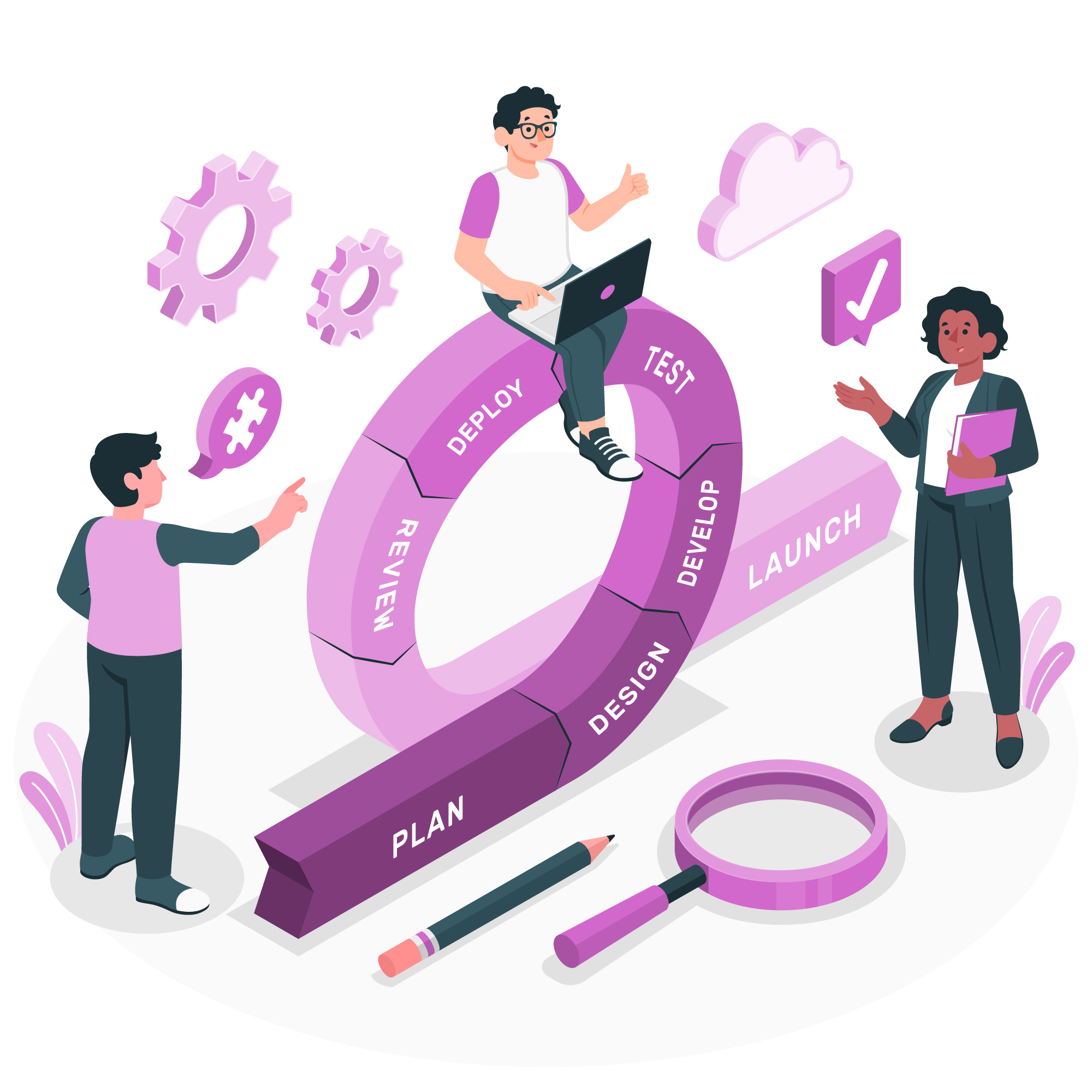
What are the 5 stages of the agile software development lifecycle?
The agile project lifecycle revolves around five essential phases:
Project initiation
This first stage aims to establish the project's foundations. It begins with defining business and functional objectives in agreement with the client. Based on this, the project team is formed by bringing together the necessary skills: developers, testers, project manager, etc. User needs are then identified and prioritized according to their added value for the client. This allows for planning the features to be developed in the initial sprints, starting with the most critical ones. Finally, the scope and overall schedule are defined in the form of a feature delivery roadmap.
Planning
This stage precedes each sprint to precisely define its content. The team selects from the prioritized features those that can be developed in the upcoming sprint. To do this, it relies on velocity, an indicator that measures its production capacity. The client validates that the features align with their current expectations. Once the sprint scope is defined, the team plans task allocation: who will do what and when. Developers estimate the time required for each task. Finally, a measurable objective is set for the sprint (e.g., number of features delivered).
Development
During this phase, the team collaboratively builds the features planned during the planning stage. It organizes itself according to its own working methods, while respecting the agile framework. Daily rituals like stand-up meetings help coordinate progress. Depending on the practices chosen, developers may work in pairs (a practice from Extreme Programming) and frequently use continuous integration to merge their code. Automated regression tests check that each update does not break existing features.
Production
At the end of the sprint, the team delivers an operational version integrating the newly developed and tested features. This version is demonstrated to the client, who validates its alignment with their current expectations. Based on user experience and client feedback, corrections and improvements can be quickly integrated into the version. Once validated, this incremental version is deployed to production for actual use by end-users.
Product withdrawal
This final stage occurs when software reaches its end-of-life and must be gradually withdrawn from production and decommissioned. Several scenarios can lead to this withdrawal. The most common is the launch of a new major version that renders the old one obsolete. As the old version is no longer maintained, clients are informed of its upcoming decommissioning and assisted with migration. Withdrawal can also occur if the software is no longer economically viable. Clients are then notified of its gradual discontinuation and guided towards alternative solutions. In all cases, end-of-life means the cessation of product support and updates. The team now focuses on maintaining operational conditions and transitioning clients to new solutions.
Why combine agile methodology and digital transformation?
Three major reasons support this combination. Firstly, digital transformation imposes a rapid pace of change on organizations. Technologies and practices are evolving at lightning speed. To keep up with these perpetual changes, businesses must become more agile, or risk quickly becoming obsolete. In this regard, agile methodologies provide them with the necessary adaptability. Furthermore, agile software development relies on frequent deliveries of operational versions. This approach allows end-users to quickly test functionalities. Their feedback fuels continuous product improvements. This helps identify and correct potential missteps as early as possible. Moreover, continuous communication among all stakeholders, both external and internal to the project, ensures strong responsiveness. Market expectations are captured in real time so the product can evolve accordingly.
How do you run a successful agile transformation?
Moving from a few agile teams to an agile organization is a cultural change as much as a change of method. A few guidelines:
- Start from business value: choose a first scope where fast deliveries bring a visible benefit, such as a customer journey or an internal process.
- Launch pilot teams: cross-functional teams with an available, empowered Product Owner, then scale up gradually.
- Train and support managers: their role shifts from controlling tasks to clarifying priorities and removing obstacles.
- Adapt governance: fund products rather than projects, track value delivered and arbitrate more often.
- Support users at every release: in agile, applications change every few weeks. Without information and contextual help, these repeated changes wear users out and slow down digital adoption.
- Measure and adjust: retrospectives, user feedback and usage data help you improve the transformation itself.
The main obstacles are human: work habits, fear of losing control and resistance to change. You address them by leading by example, being transparent about results and keeping a sustainable pace of change.
Conclusion
Ultimately, agile methodologies combine speed of execution with adaptability in a constantly changing environment. This agility is essential for successfully implementing digital transformation within organizations. The alliance of these two approaches generates a powerful evolutionary dynamic. Organizations that combine both approaches are better placed to keep pace with their markets. They will be able to navigate the dynamic digital landscape with ease, always staying in tune with market expectations. Responsiveness and proactivity will become their watchwords.
Frequently asked questions
What is the difference between agile adoption and agile transformation?
Agile adoption usually means that one or a few teams start using an agile framework such as Scrum or Kanban. Agile transformation goes further: it changes how the whole organization makes decisions, funds work, manages people and measures results. An agile transformation often starts with agile adoption in pilot teams before scaling to other departments.
What is the difference between agile and waterfall?
The waterfall model runs sequential phases: complete specifications, design, development, then testing and acceptance at the end of the project. The agile method splits the project into short iterations that each deliver a usable, tested version adjusted with the customer. Agile works better when requirements are uncertain or likely to change; waterfall suits stable, well-known scopes with strict regulatory constraints.
Which agile framework should you choose for a digital transformation project?
Scrum suits development or configuration projects run by a dedicated team with regular sprints. Kanban suits continuous flows of requests, such as application support or maintenance. To coordinate several teams on the same digital transformation program, organizations use scaled agile frameworks. The choice depends on the size of the program and the maturity of the teams.
How long is a sprint in agile?
In Scrum, a sprint lasts one month or less, most often two to four weeks. Its length stays fixed throughout the project to give the team a steady rhythm. Each sprint starts with Sprint Planning and ends with a Sprint Review, where the increment is presented to stakeholders, followed by a Sprint Retrospective focused on improving how the team works.
Why do agile transformations fail?
Agile transformations often fail when they stop at rituals such as sprints and daily stand-ups without changing governance or the role of managers. Other frequent causes include a Product Owner with no decision-making power, teams that depend on other departments to deliver, and end users left without support while their tools change every few weeks.
Sources
- Atlassian, "Agile Manifesto for Software Development" (text of the 2001 Manifesto for Agile Software Development), accessed October 2026
- Ken Schwaber and Jeff Sutherland, "The Scrum Guide", November 2020
- Cegid / IDC France, study on the digital transformation of French companies (480 companies surveyed, May to July 2020), published October 6, 2020 (in French)