PLM (product lifecycle management) is both a business approach and a category of software for managing a product from the first idea to end of life. A PLM system keeps CAD files, bills of materials, specifications and change history in one place, so engineering, quality, purchasing, manufacturing and suppliers all work from the same up-to-date product data.
Key takeaways
- PLM stands for product lifecycle management: managing a product from concept to end of life.
- PLM is both a business approach and a set of software tools that centralize product data such as CAD files, bills of materials and changes.
- PLM complements ERP and CRM: PLM defines the product, ERP executes its production and sale.
- PLM delivers value only when it is adopted by every function, well beyond the engineering department.
Introduction
Product Lifecycle Management (PLM) has emerged as a strategic solution for optimizing industrial processes. From design to maintenance, PLM facilitates cross-departmental collaboration, centralizes data, and ensures compliance with standards. So, why has this approach become essential for modern businesses? Here's an overview of its benefits.
Related use case: PLM system implementation for every role
1. The History of PLM
The history of PLM (Product Lifecycle Management) dates back to the 1980s, when companies began to realize that managing their products was becoming increasingly complex, particularly due to market globalization, product range diversification, and increased competition. At that time, companies started using CAD (Computer-Aided Design) systems to design their products. However, these systems were often isolated from each other, making it difficult to manage the entire product lifecycle. Indeed, corporate information systems were often the result of a long succession of implementations that led to a siloed system. This system, composed of a multitude of departments and applications (R&D, Marketing, Production, etc.), thus encountered multiple breaks in digital flows between the various information systems (associated with each department), leading to errors. In the 1990s, companies began developing integrated PLM systems, which allowed them to manage the entire product lifecycle from a single platform. These systems notably enabled tracking product modifications, managing supplier and customer data, monitoring production costs, planning product launches, and managing technical documents. Over the years, PLM systems have evolved to become increasingly sophisticated, integrating features for simulation, data analysis, process optimization, and real-time team collaboration. Today, PLM has become an indispensable tool for many companies, particularly in the manufacturing (including luxury and fashion), aerospace, automotive, energy, and retail sectors.
2. PLM: A Holistic Approach
PLM is often presented as software, but it is first and foremost a holistic approach. It standardizes methods, interactions, and the integration of various software used to manage the entire product lifecycle, from creation and development phases to end-of-life. PLM accelerates the market launch of product innovations, improves product quality while optimizing development costs and timelines. It enables the digitalization of all product lifecycle data and becomes the central access point for information updated in real time. However, to fully leverage the benefits of PLM, the software used must be utilized efficiently and operated effectively.
What are the stages of the product lifecycle?
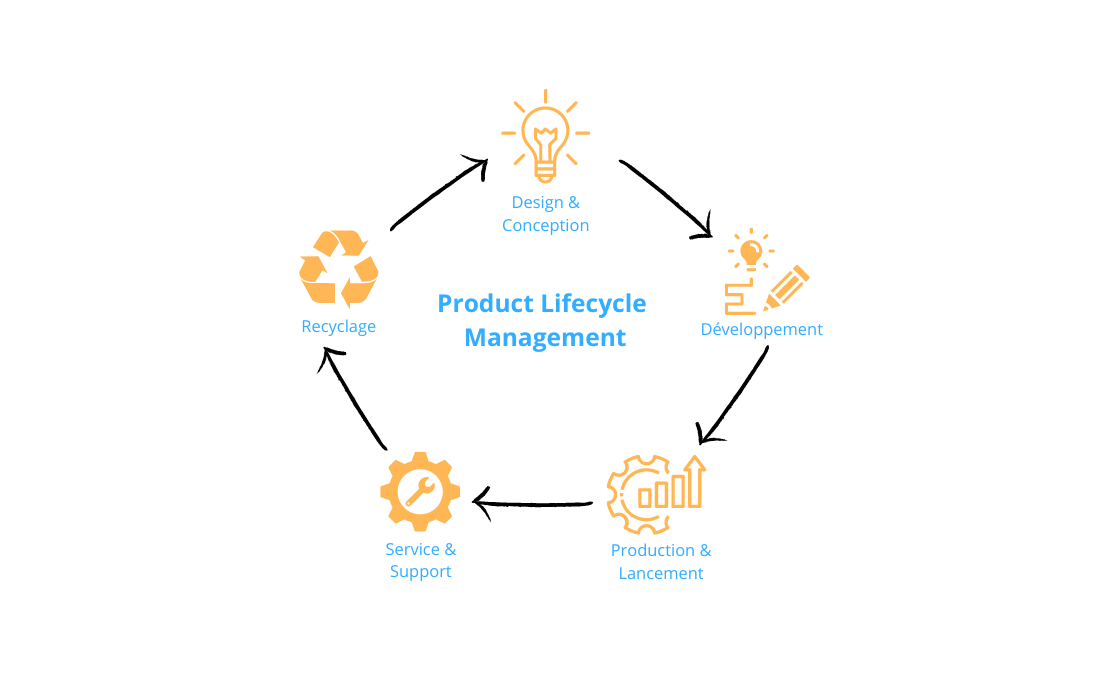
PLM supports a product through each major phase of its life. IBM distinguishes five broad stages:
- Concept: idea, market research, requirements and feasibility.
- Design and development: CAD modeling, prototypes, simulation, engineering bill of materials.
- Production and launch: industrialization, manufacturing routings, market launch.
- Service and support: maintenance, spare parts, field feedback, product updates.
- End of life: withdrawal from the market, recycling, data archiving.
At every stage, PLM keeps a single, current version of product information. A defect reported during service can trigger a change request that is traced all the way back to design. This continuous flow of data, often called the digital thread, is what sets PLM apart from a simple document repository. PLM is therefore not reserved for engineers: marketing, purchasing, quality and after-sales service all contribute to it and draw the information they need from it. In fashion and retail, the same logic applies to each collection: line planning, tech packs, sampling and supplier approvals.
3. PLM: An Essential Complement to ERP and CRM
PLM goes far beyond a simple tool. It complements ERP and CRM solutions by centralizing technical data and fostering cross-departmental collaboration. Its main benefits:
- Technical Data Management: Protecting and organizing engineering department data.
- Multidisciplinary bills of materials: Facilitating exchanges between mechanical, electronic, and software teams.
- Compliance: Ensuring adherence to environmental, safety, and quality standards.
Application Example: A manufacturing company can use PLM to synchronize design and production teams, thereby reducing time-to-market.
PLM vs PDM vs ERP vs PIM: what's the difference?
These four acronyms are often confused, yet they cover distinct and complementary scopes:
| System | Main role | Main users |
|---|---|---|
| PDM (product data management) | Manage CAD files and technical documents; historically the foundation of PLM | Engineering |
| PLM (product lifecycle management) | Manage the whole lifecycle: requirements, bills of materials, changes, compliance | R&D, manufacturing engineering, quality, purchasing, suppliers |
| ERP (enterprise resource planning) | Execute: purchasing, inventory, production, sales, finance | Operations, supply chain, finance |
| PIM (product information management) | Enrich and publish marketing product information | Marketing, e-commerce |
PDM is now usually a module of PLM, while PIM remains a separate tool fed by PLM or ERP. In practice, PLM sends a released bill of materials to the ERP system, and the PIM reuses product characteristics for sales channels. The boundary matters when you choose tools: a company that only needs to secure CAD files can start with PDM, while one that manages variants, regulations and many suppliers needs full PLM. Looking for a tool? See our comparison of PLM software and its selection criteria.
4. Managing the data deluge to organize your business
With the exponential growth of data, PLM offers powerful indexing tools to:
- Quickly find relevant information.
- Optimize project management: budget, planning, risk monitoring.
- Ensure a real-time global view through active team collaboration.
Tip: With PLM, companies can detect risks and solve problems before they affect their operations.
5. Breaking down departmental silos to manage changes
The frequency of product changes continues to increase. PLM secures this process through the management of:
- Change requests (ECRs).
- Change orders (ECOs).
- Change actions.
Benefits:
- Measure the impact of changes on design, production, and budget.
- Reduce errors and delays through single access to shared data.
6. Digital continuity for a unified ecosystem
PLM extends beyond the enterprise by connecting all stakeholders, including subcontractors and customers. Its benefits:
- Real-time collaboration between sites and teams.
- Access to data from anywhere, ideal for remote work and mobile employees.
- Customer interaction: change requests, spare parts orders.
Concrete example: A multi-site company can synchronize its global operations in real time, thereby improving its productivity and responsiveness.
Adopt PLM with K-Now
To effectively integrate a PLM solution, it is essential to ensure its adoption by all your teams. With K-Now, our application GPS, simplify the adoption of digital tools and ensure successful uptake by your employees. Benefit from a solution that supports your teams with:
- Interactive tutorials.
- Personalized training.
- Real-time support to optimize your digital transformation.
Conclusion
Adopting Product Lifecycle Management means investing in a solution that centralizes data, improves collaboration, and fosters agility. With enhanced digital continuity, PLM creates a unique ecosystem to boost your performance. To get started, map your current product development processes, then compare PLM software against your needs and your teams' ability to adopt it.
Frequently asked questions
What does PLM stand for?
PLM stands for product lifecycle management. The term covers both a business approach, which organizes collaboration around the product, and the software that supports it by centralizing technical data from the initial idea to the product's end of life. In fashion and retail, PLM also manages collections, materials and suppliers.
What is an example of PLM software?
Well-known examples of PLM software include Siemens Teamcenter, PTC Windchill, Dassault Systèmes 3DEXPERIENCE, Aras Innovator and Oracle Fusion Cloud PLM for engineering-driven industries, and Centric PLM for fashion, retail and consumer goods. Each targets different industries and company sizes; see our PLM software comparison for strengths and selection criteria.
Is SAP a PLM system?
SAP is first and foremost an ERP vendor, but it offers PLM capabilities integrated with SAP S/4HANA, such as product structures, recipes and engineering change management. Many manufacturers pair SAP ERP with a dedicated PLM: SAP and Siemens, for example, have partnered since 2020 to integrate Teamcenter with SAP.
What does a PLM role involve?
A PLM role, such as PLM consultant, administrator or manager, helps a company structure its product development processes: analyzing needs, configuring the PLM system, migrating data, managing change requests and supporting users. It bridges engineering, quality, purchasing and IT, often on behalf of an integrator or software vendor.
Is PLM only for large manufacturers?
No. Aerospace and automotive groups were the first PLM users, but cloud offerings and solutions designed for small and mid-sized manufacturers have broadened access. For a smaller company, the key is to start with a limited scope, often CAD data and bills of materials, then extend PLM to changes, quality and suppliers step by step.
Sources
- Dassault Systèmes, "Product Lifecycle Management: What is PLM software?", accessed October 2026
- Oracle, "What Is PLM Software?", updated May 13, 2022
- IBM Think, "What Is Product Lifecycle Management?", Chrystal R. China, February 18, 2025
- Siemens Teamcenter blog, "SAP and Siemens Teamcenter PLM", February 25, 2025