PLM software (product lifecycle management software) is the system of record for product data: CAD files, bills of materials, specifications, changes and compliance records, from first concept to end of life. Leading solutions include Siemens Teamcenter, PTC Windchill, Dassault Systèmes 3DEXPERIENCE, Aras, Centric PLM and Visiativ PLM. The right choice depends on your industry, your CAD and ERP integrations, and your hosting model.
Key takeaways
- PLM software is the single source of truth for product data, from design to withdrawal from the market.
- Leading solutions include 3DEXPERIENCE (Dassault Systèmes), Windchill (PTC), Teamcenter (Siemens), Aras, Centric PLM and Visiativ PLM.
- Your choice depends on industry fit, CAD and ERP integrations, hosting model (on-premise or SaaS) and total cost of ownership.
- PLM software only creates value if it is adopted by every function, not just engineering.
With the rapid development of the Cloud, the deployment of Industry 4.0, and the emergence of new technologies like the digital twin, the PLM (Product Lifecycle Management) solutions market is currently experiencing strong growth. Discover all the information to seize this opportunity.
What is PLM (Product Lifecycle Management) and how is it used?
A brief history of PLM and product lifecycle management
The first Product Lifecycle Management (PLM) solutions emerged in the 1980s in response to the increasing complexity of product management for businesses. Various factors such as market globalization, the growing complexity of the supply chain, product range diversification, and increased competition necessitated a more integrated approach. Furthermore, PLM helped break down information systems that were operating in silos, consisting of multiple applications for each department, such as R&D, marketing, production, maintenance, and so on. Over time, PLM systems evolved to become increasingly sophisticated, integrating features such as data analysis, process improvement and monitoring, and real-time collaboration. They enable the management of a product's entire lifecycle, from its initial design to its market withdrawal.
Related use case: PLM system implementation for every role
Why use a PLM solution?
A PLM solution offers numerous benefits.
First, it enables the centralization of all product-related data throughout their lifecycle. This includes, for example, specifications, plans, 3D models, costs, deadlines, regulations, suppliers, modifications, and versions. Centralizing this data fosters collaboration between teams, facilitates the sharing of key information, and prevents loss, dispersion, or duplication. Second, PLM platforms help break down silos between design, production, market launch, and support processes. This real-time, global availability of information enhances transparency and decision-making. The "silo effect" is avoided, leading to greater agility and a deeper understanding of customers and products. Employees are empowered by gaining a comprehensive yet concise and clear overview. Furthermore, a PLM solution allows for the automation of certain business processes, particularly those related to product development and management. For instance, it's possible to automate workflows, approvals, notifications, and recurring tasks to improve everyone's efficiency and productivity. Manual processes and the risk of human errors are reduced. Finally, a PLM solution also provides complete traceability. Managers can track every step, from initial design to market withdrawal. It also allows for the identification of existing elements that can be reused in future projects.
How does PLM work?
The process of using a PLM solution is generally divided into three stages: manage, collaborate, and oversee.
The first stage is the management of all product-related data throughout its lifecycle. As we've seen, this includes the creation and management of specifications, technical documents, 3D/2D models, costs, deadlines, regulations, etc. The PLM solution organizes this data in a structured way and makes it accessible to all stakeholders. The second stage is collaboration, which involves sharing and exchanging information between internal teams and external stakeholders. The solution facilitates collaboration by enabling different teams (design, engineering, production, marketing, etc.) to work transparently and in a coordinated manner. The third stage is oversight, which encompasses the supervision and control of the product development and management process through monitoring, reporting, and analysis features. These features allow for tracking key performance indicators, monitoring project progress, managing changes, assessing risks, and optimizing the product's overall performance.
What are the key features of PLM software?
PLM grew out of product data management (PDM), which focused on CAD files and documents. In the 1990s, vendors added collaboration, quality, manufacturing and compliance capabilities, as Oracle recounts. Today's PLM software typically covers six building blocks:
- Product data management (PDM): secure vault for CAD files, versions and access rights.
- Bills of materials: engineering and manufacturing BOM structures, including variants.
- Change management: change requests and change orders, impact analysis, approval workflows.
- Quality and compliance: requirements, regulations, materials and substances, traceability.
- Collaboration: secure sharing with other sites, subcontractors and suppliers.
- Integrations: connectors to CAD, ERP and MES to keep data continuous down to the shop floor.
Industry-specific modules come on top: collection, materials and sourcing management in fashion, formulation in cosmetics and food, engineering program management in aerospace. Most companies do not deploy every block at once: they start with PDM and BOMs, then extend PLM to change management, quality and supplier collaboration as adoption grows.
How to choose the right PLM tool
The benefits and features of Cloud and On-Premise
Companies have a choice between two options for hosting their product lifecycle management solution: Cloud and On-Premise.
Cloud offers several advantages, such as remote accessibility, flexibility, scalability, and ease of implementation. Cloud-based solutions allow companies to access PLM functionalities via the internet, without requiring costly internal infrastructure. Furthermore, software updates are managed by the provider, which automatically provides the latest features and improvements. On the other hand, On-Premise refers to installing the PLM tool directly on the company's internal servers. This approach offers total control over the infrastructure and data, as well as more extensive customization of the tool based on the company's specific needs. However, On-Premise requires internal resources for software management and maintenance, as well as higher initial investments.
How to make your choice?
To choose between the two solutions, you can evaluate several criteria. The most important factor is the criticality level of the data you will entrust to your PLM solution. If this data is subject to specific regulations or requires a high level of confidentiality, then an On-Premise solution might be preferable. If you have limited internal resources, it may be wise to opt for a Cloud solution, which will be easy to deploy for your teams and require little maintenance, even during updates.
PLM Software: Solutions for Every Challenge
1. 3DEXPERIENCE by Dassault Systèmes
Dassault Systèmes has been a pioneer in developing PLM solutions. The 3DEXPERIENCE platform is naturally designed for industrial sectors, particularly aerospace, defense, and automotive. It enables the lifecycle management of complex products involving hundreds or thousands of people. Among 3DX's features are real-time collaboration, data management, simulation, analysis, planning, and product traceability.
Key strength : a robust and flexible architecture.
Key weakness: a high cost, which makes it best suited to large-scale projects.
Who is it for? Ambitious projects looking to embrace Industry 4.0.
References: Bouygues Construction…
2. Windchill by PTC
Windchill is an engineering PLM focused on product data and change management. This solution offers advanced features such as data and change management, real-time collaboration, traceability, and 2D and 3D product visualization. Windchill mainly serves discrete manufacturers; for fashion and retail, PTC offers a separate solution, FlexPLM. Windchill enables teams to work synchronously and optimize development processes.
Key strength : a platform natively designed for global operation.
Key weakness: compatibility with other APIs.
Who is it for? Manufacturers that design complex products across multiple sites.
References: Vaillant Group…
3. Teamcenter by Siemens
Teamcenter, developed by Siemens, is a comprehensive PLM solution, widely used by large manufacturers in automotive, aerospace, machinery and electronics. It enables real-time product data management, collaboration, planning, and more, anywhere in the world. Its visualization system makes it a powerful decision-making tool for management and executives.
Key strength : its compatibility and integration with other APIs, and its availability on various operating systems.
Key weakness: a rich platform that usually requires an integrator to deploy. Note that Teamcenter runs on premise, while Teamcenter X is the SaaS version operated by Siemens.
Who is it for? Manufacturers, from mid-sized companies to large groups, that manage complex, multi-site products.
References:
4. Aras
Aras is an established PLM vendor known for its Aras Innovator platform. Its low-code platform stands out for its high flexibility and integration capabilities with third-party applications. It can be adapted to the specific processes and challenges of each company and department. This highly customizable solution is supported by a community and forums.
Key strength: its rapid deployment within teams.
Key weakness: strong in-house technical skills are essential to fully leverage the platform's potential.
Who is it for? Aras primarily targets companies in the industrial sector. It notably offers a digital twin solution.
References: Airbus, Motorola…
5. Centric PLM
Finally, Centric PLM is a platform designed for fashion, retail and consumer goods. It offers advanced features accessible, for example, to designers or developers who can manage products by collection. It also allows for the visualization of product data, suppliers, and sourcing, which enables real-time cost tracking.
Key strength: its specialization in the retail sector and the introduction of predictive AI.
Key weakness : third-party application integration.
Who is it for? Primarily retailers with international expansion.
References: Kering, Louis Vuitton, Asics…
6. Visiativ PLM
Visiativ PLM is a Product Lifecycle Management solution specifically designed for industrial SMEs and mid-market companies. It stands out for its sectoral approach and integration with business software, thereby facilitating the digital transformation of companies. The solution offers essential features such as product data management, team collaboration, process automation, and integration with ERP tools. Visiativ PLM also offers extensive customization to adapt to the specific needs of each company, while maintaining an intuitive user experience.
Key strength: an accessible and flexible solution, designed for SMEs and mid-market companies.
Key weakness: more limited functional coverage than solutions designed for large corporations.
Who is it for? Small and mid-sized manufacturers seeking a powerful and adaptable tool to structure their product lifecycle management.
References: Maped, Weleda, SIMP, Radiall, Clayens…
Comparison of PLM Solutions
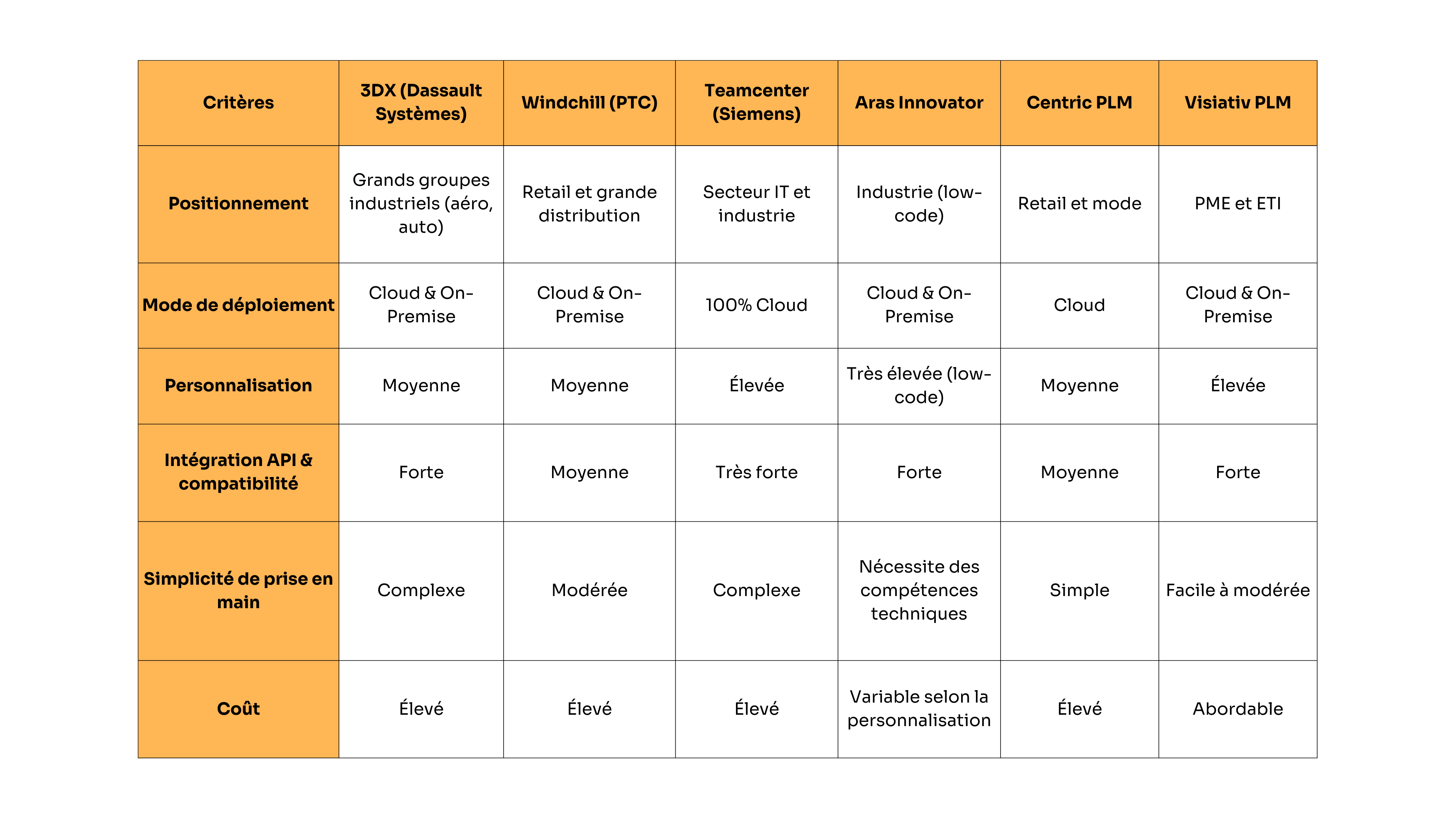
How to choose PLM software: 6 criteria
- Industry fit: a PLM built for discrete manufacturing (parts, assemblies, complex BOMs) does not meet the same needs as a fashion and retail PLM (collections, materials, suppliers).
- Integrations: check native connectors to your CAD tools and your ERP, and the quality of the APIs.
- Deployment model: major vendors increasingly offer SaaS alongside on-premise installation. Siemens, for example, sells Teamcenter X, a cloud version operated and updated by Siemens, in addition to on-premise Teamcenter.
- Total cost of ownership: licenses or subscriptions, integration, data migration, configuration, training and maintenance.
- Ecosystem: local integrators, user community and the vendor's roadmap.
- Adoption across functions: PLM is used well beyond engineering (purchasing, quality, marketing, production). Test usability with real users and plan training and support from the start, as for any new business software implementation.
Tip: ask shortlisted vendors to demo your own use cases, such as one product change handled end to end, rather than a standard presentation.
Frequently asked questions
What is the best PLM software?
There is no single best PLM software. Siemens Teamcenter, PTC Windchill and Dassault Systèmes 3DEXPERIENCE are references for complex manufacturing; Centric PLM targets fashion, retail and consumer goods; Visiativ PLM serves small and mid-sized manufacturers; Aras offers a customizable low-code platform. The best PLM software is the one that covers your processes, integrates with your CAD and ERP, and is actually adopted by your teams.
What is the difference between PLM and ERP?
PLM manages the definition of the product: design, engineering bill of materials, changes and technical documentation. ERP manages execution: purchasing, inventory, production, sales and accounting. PLM sends a released BOM to the ERP, which returns cost and availability data. The two systems are complementary, as we explain in our PLM vs ERP article.
Is Oracle a PLM system?
Oracle is best known for its database and ERP, but it also sells PLM software: Oracle Fusion Cloud Product Lifecycle Management, a SaaS application connected to Oracle's cloud ERP and supply chain suite, alongside its older on-premise Agile PLM. It is mostly chosen by companies that already run Oracle ERP and want product and operational data in one ecosystem.
What is cloud PLM software?
Cloud PLM software, or SaaS PLM, is hosted and operated by the vendor, which manages infrastructure, security and updates; you pay a subscription and access the tool through a browser. This lowers upfront investment and the load on your IT department but limits some customizations. It suits small and mid-sized companies and projects that need to start quickly.
How much does PLM software cost?
PLM software costs depend on the number and type of users, the modules, and the deployment model. SaaS PLM is billed per user per month; on-premise PLM requires licenses plus annual maintenance. On top come integration with CAD and ERP, data migration, configuration and training, which often weigh as much as the software itself. Ask vendors for a multi-year total cost of ownership.