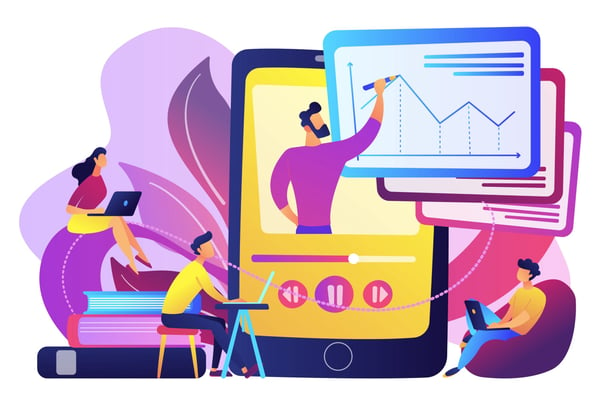
Salesforce training teaches each user to work in the CRM according to their role: sales reps, marketers, customer service agents, managers or admins. In a company, it usually combines Salesforce's free Trailhead platform, certification courses for technical profiles and in-app guidance for business users. It has to be continuous, because Salesforce ships three major releases a year.
Key takeaways
- IDC has ranked Salesforce the #1 CRM provider for 13 consecutive years, with a 20.0% market share in 2025.
- Training is essential to get value from a CRM that is feature-rich, customized for each organization and updated three times a year.
- Trailhead, Salesforce's free learning platform, suits self-paced learners, but business users mainly need training built on their own Salesforce configuration.
- Digital adoption platforms guide users inside Salesforce at the moment of need and make it easier to keep help content current after each release.
What is Salesforce?
Salesforce stands out as one of the most popular CRM (customer relationship management) solutions today. Behind this term lies software designed to optimize customer relationship management in its entirety. Simply put, Salesforce CRM centralizes all interactions between a business and its customers within a single platform.
This tool thus allows for consolidating all data related to the customer journey in a single place. From the first sales contact to customer loyalty, Salesforce supports the company by connecting different departments and channels. This CRM consolidates a large amount of information in real-time: customer data, exchange history, marketing content, key metrics, etc.
Thanks to an intuitive interface, Salesforce allows each department to easily access this valuable data. Salespeople, marketers, customer service managers – all work together. This unified information streamlines communication and internal collaboration. Furthermore, Salesforce optimizes customer targeting and tracking at every stage of the conversion funnel.
The company thus gains a 360° view of its customers, allowing it to optimize its sales and marketing approach.
Specifically, Salesforce offers a diversified range of SaaS solutions and products, such as:
- Marketing Cloud, designed to centralize a company's marketing efforts and enhance customer understanding.
- Sales Cloud, which supports sales teams in their prospecting and retention efforts.
- The Commerce Cloud, which supports the digitalization of the customer journey, and the Service Cloud, dedicated to customer service.
- Loyalty Management, to develop B2B or B2C loyalty programs.
- Marketing Cloud Intelligence (formerly Datorama) to analyze marketing data and track campaign performance.
- Mobile Studio, to send personalized SMS, MMS and push notifications.
- Data 360 (formerly Data Cloud), which unifies customer data for marketing, sales and service.
- Email Studio, to design impactful email campaigns.
The vendor thus leverages highly comprehensive business solutions to transform data into actionable insights. This broad product portfolio meets the needs of all departments, whether marketing, sales, e-commerce, or customer service. It reflects Salesforce CRM's ambition to establish itself as a global business partner.
Why get trained in Salesforce CRM?
Many arguments position Salesforce CRM training as a strategic imperative:
- Market Leader: IDC has ranked Salesforce the #1 CRM provider for 13 consecutive years, with a 20.0% market share in 2025. Training is therefore a natural step if your organization has opted for this CRM solution.
- Required Expertise: while Salesforce is intuitive, leveraging its advanced potential requires solid expertise gained through training.
- Change Management Support: training removes inhibitions and helps sales teams adopt this new tool.
- Frequent Updates: with three major releases a year (Spring, Summer and Winter), regular training is essential to master each new version.
- Tailored Customization: training helps identify specific uses to leverage "your" personalized Salesforce CRM.
How to learn Salesforce: Trailhead, a training provider or in-house training?
Salesforce is the CRM most organizations end up training on: IDC has ranked it the #1 CRM provider for 13 years in a row. Several training routes coexist, and the right one depends on who you are training:
| Option | Best for | Strengths | Limits |
|---|---|---|---|
| Trailhead, Salesforce's official learning platform | Beginners, admins, developers, certification candidates | Free hands-on modules; prepares for 60+ official certifications | Standard content, without your configuration or processes |
| Training provider or systems integrator | Admins, consultants, project teams | Expert instructor, certification prep | One-off sessions, cost, time away from work |
| In-house training on your own Salesforce org | Sales reps, marketers, service agents, managers | Exercises on your own screens and business rules, for example in a software simulation | Content must be produced and updated at every change |
| In-app guidance (DAP) | All users, new hires | Step-by-step help at the moment of the task | Complements initial training rather than replacing it |
For a sales team, Trailhead alone is rarely enough: every company customizes its objects, opportunity stages and validation rules. Your users need to learn your Salesforce, not just standard Salesforce.
The Benefits of DAPs for Salesforce Training
Rapid Onboarding
Digital adoption platforms dedicated to Salesforce CRM enable new users to get started with the tool particularly quickly. Thanks to immersive journeys organized by persona and punctuated by concrete challenges, they directly immerse the learner in the heart of the action.
This hands-on training, in a realistic work situation, significantly accelerates skill development. It helps users quickly become autonomous on essential tasks.
Onboarding is thus carried out dynamically and efficiently.
Fun and Practical Training
Beyond speed, DAPs leverage gamification and interactivity to boost user engagement during training.
Thanks to a wide variety of activities (videos, tutorials, quizzes, challenges), they stimulate participation while firmly embedding knowledge.
This emphasis on " learning by doing" through realistic simulations enhances the practical and concrete nature of CRM skill development. Training becomes more attractive and relevant.
Accessible 24/7
Unlike traditional in-person training, DAPs are accessible at any time, adapting to the learner's pace. This flexibility allows each user to train at their own speed, whenever they wish. They can thus build a learning path tailored to their availability.
This 24/7 accessibility from any connected device changes the approach. Gone are the intensive, block-based sessions; instead, targeted micro-learning focused on business tasks is delivered on an ongoing basis.
This fragmented, capsule-based approach promotes skill retention.
Personalized Learning Path
Digital adoption platforms also focus on hyper-personalizing learning paths with automated recommendations for tailored content.
This continuous adjustment of CRM training paths according to each individual's level and specific needs makes skill development more progressive and relevant; users only train on topics useful for their job and expertise level.
Evolving Training
Finally, DAPs make it easier to update training content continuously to reflect the latest features of the Salesforce CRM.
Coupled with active monitoring of CRM solution developments, they enable teams to be continuously trained on the very latest advancements.
Digital training paths thus evolve at the same rapid pace as Salesforce for perfect alignment. This regular updating of educational content according to CRM versions keeps user skills current.
K-NOW helps you design and distribute useful business aids to your employees daily, saving them time and reducing the risk of errors.
How should you organize Salesforce training for your users?
- Segment by role: a sales rep, a manager and a service agent do not use the same screens or reports. Define the key tasks each role must master.
- Train on real cases: create an account, qualify a lead, move an opportunity forward, log an activity, read a dashboard.
- Support users inside the tool after training: step-by-step walkthroughs and contextual help keep new skills from fading in the first weeks.
- Prepare for every release: review the release notes, identify what changes for your users and update training and in-app help before the release reaches them.
- Measure usage: logins, activity logging, record completeness, report usage. These indicators show which teams need support first, because software can stay underused despite training.
Organized this way, Salesforce training stops being a one-off event and becomes a continuous program, aligned with the CRM's release cycle and with each team's real needs.
Conclusion
Salesforce CRM thus stands out as a leading tool for optimizing customer relationships, especially in a context of accelerated digitalization of customer journeys. Mastering this leading, multi-functional CRM is therefore indispensable for any organization looking to kickstart its digital transformation.
However, fully leveraging the power of this solution requires going beyond simple self-taught learning. Only relevant and continuous training allows you to take advantage of Salesforce's multitude of advanced features and rapid developments. It ensures the necessary expertise to transform this tool into a true strategic lever for commercial and marketing performance.
Digital adoption platforms are an effective way to acquire Salesforce skills within organizations. With their virtues of hyper-personalization, flexibility, and interactivity, this engaging and evolving approach to user training ideally addresses the challenges of long-term expertise development. Beyond Salesforce, the promise of DAPs remains that of a successful digital transformation, driven by fully engaged and empowered employees.
As digital adoption experts, Knowmore supports you in training and successful adoption of Salesforce within your organization. Thanks to our dedicated Digital Adoption Platform, we design custom immersive learning paths to train your teams on the various roles and uses of Salesforce. Your employees get the most out of your CRM.
Frequently asked questions
Is Salesforce training free?
Partly. Salesforce offers Trailhead, its official learning platform, where the hands-on modules are free and prepare learners for more than 60 Salesforce certifications. Instructor-led courses, training providers and programs built on your company's own Salesforce configuration are usually paid. Most organizations combine free Trailhead content with role-based training on their own setup.
Is Salesforce hard to learn?
Salesforce is not hard to learn for everyday tasks such as updating leads, opportunities and activities, especially when training uses your own configuration. It becomes demanding for administrators and developers, who must master customization, automation with Flow, security and data quality. The difficulty also grows with each customization your company adds to the CRM.
How long does it take to learn Salesforce?
How long it takes to learn Salesforce depends on the role. A business user can handle daily tasks after a few practical sessions on real cases. An administrator or developer needs several months of study, often punctuated by certifications. In every case, skills need refreshing at each of Salesforce's three annual releases.
What is the difference between Salesforce user training and admin training?
Salesforce user training teaches people to work in the CRM: entering and tracking accounts, leads and opportunities, and reading dashboards and reports. Salesforce admin training covers configuration: users and permissions, custom objects and fields, automation, security and data quality. The two audiences have different goals and need separate learning paths.
Do you need a Salesforce certification to use Salesforce?
No. A Salesforce certification is not required to use the CRM day to day. Certifications validate the skills of admins, developers and consultants and matter mostly to people who work on Salesforce professionally. Sales reps and other business users need training focused on their own tasks and on their company's configuration instead.
Sources
- Salesforce, "Salesforce Ranked #1 CRM Provider for 13th Consecutive Year" (IDC data), June 4, 2026
- Salesforce, "Salesforce Winter '27 Release" (three seasonal releases a year), accessed October 2026
- Salesforce Trailhead, "Trailhead | The fun way to learn" (free hands-on training, 60+ certifications), accessed October 2026