
Key takeaways
- The Deming cycle, or PDCA cycle, structures continuous improvement in four repeated steps: Plan, Do, Check and Act.
- Walter A. Shewhart developed the cycle in the late 1920s; W. Edwards Deming popularized it from the 1950s and later preferred PDSA (Study).
- Each cycle tests a change on a small scale, then standardizes what works before starting again.
- ISO 9001 is based on the plan-do-check-act method, which makes PDCA the backbone of many quality management systems.
The Deming Cycle, also known by the acronym PDCA "Plan Do Check Act", is a continuous improvement method proven for decades. It aims to continuously manage and optimize processes within organizations. By providing a structured framework for action, the Deming Cycle helps companies increase their operational performance and long-term competitiveness.
What is the Deming Cycle?
Definition
The Deming Cycle, also known as the PDCA cycle (Plan, Do, Check, Act), is a management method popularized in the 1950s by American statistician W. Edwards Deming, building on the work of Walter A. Shewhart in the late 1920s. Its objective is to structure continuous improvement initiatives within organizations. Rather than optimizing specific processes on an ad-hoc basis, the Deming Cycle establishes a culture of continuous improvement for processes, products, and services. In practice, this method relies on a cyclical and iterative 4-step approach. Each cycle allows for identifying areas for improvement, implementing them, and evaluating the results in a continuous optimization logic.
Key Benefits
Applying the Deming Cycle in business offers multiple benefits and advantages:
- Quality Optimization: the continuous pursuit of improvements results in enhanced quality of products, services, and processes.
- Increased Flexibility: the regular re-evaluation of work methods stimulates innovation and organizational agility.
- Operational efficiency: malfunctions are identified and corrected quickly, preventing recurring issues.
- Team involvement: the approach relies on the contribution of all employees, which is a source of motivation.
- Fact-based decision making: adjustments are based on objective data analysis rather than intuition.
- Enhanced competitiveness: by continuously optimizing its operations, the company increases its ability to adapt to market changes.
In short, the Deming Cycle provides a methodical framework for continuously improving organizational performance. It is a powerful management tool for gaining agility and competitiveness in the long term.
What are the steps of the Deming Cycle?
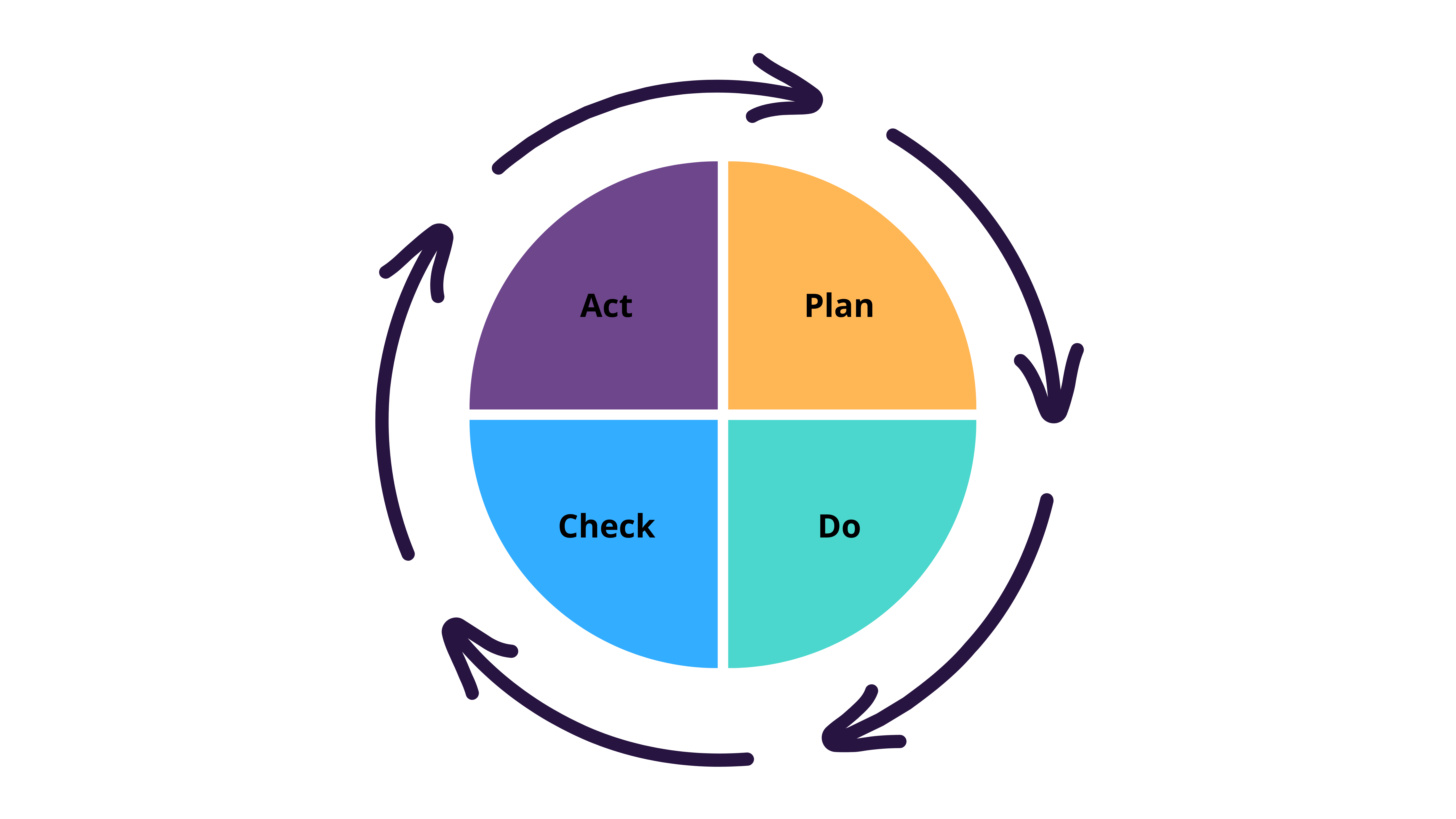
As mentioned previously, the Deming Cycle is based on 4 key steps:
Plan
This first step aims to define the objectives to be achieved for improving quality and performance. Based on an analysis of the current situation, quantifiable indicators are established. An action plan is then developed, detailing the tasks, resources, and deadlines for achieving the objectives. This rigorous planning is essential for successfully carrying out the subsequent steps.
Do
During this implementation phase, the action plan is deployed on a small scale by operational teams. Employees are trained if necessary. This localized experimentation allows for testing the plan's validity before a full-scale deployment. Any necessary adjustments are integrated progressively to optimize the plan.
Check
This step involves evaluating the results achieved by comparing measured indicators against the initially set objectives. This factual analysis identifies any discrepancies and their origins. The root causes of problems are investigated using quality tools (Ishikawa diagrams, 5M, 5 Whys, etc.). This crucial stage provides objective insight into whether improvements have been made.
Act
Based on the insights from the previous step, corrective actions are initiated to resolve difficulties and achieve objectives. The action plan is adjusted accordingly for the next iteration. Validated changes are then scaled up. A new PDCA cycle can then restart on optimized foundations. The virtuous sequence of these four steps embodies best practices for continuous improvement: plan, test, evaluate, adjust, and repeat. The Deming Wheel provides a proven framework for progress.
Which tools can you use at each step of the PDCA cycle?
The American Society for Quality summarizes the cycle in four actions: recognize an opportunity and plan a change, test it on a small scale, review the results, then act on what you learned. Each step relies on classic quality tools:
| Step | Key question | Common tools |
|---|---|---|
| Plan | What is the problem, its root cause and the target? | Problem statement, Ishikawa (fishbone) diagram, 5 Whys, SMART objectives |
| Do | How do we test the change on a small scale? | Action plan, pilot on a limited scope, training of the teams involved |
| Check | Did we reach the target? | Indicators, Pareto chart, control charts, before/after comparison |
| Act | Standardize or adjust? | Updated procedures and work instructions, lessons learned, next cycle |
PDCA cycle example: improving the use of a new business application
Suppose a sales team underuses a newly deployed CRM. Plan: usage data shows that half of the opportunities are still tracked in spreadsheets; the target is to log all new opportunities in the CRM within one quarter. Do: one pilot team gets a short training session and step-by-step guidance on opportunity entry. Check: after six weeks, compare the pilot team's entry rate with other teams. Act: if the gap is clear, roll the approach out to all teams and update the onboarding path; if not, adjust the plan and run a new cycle.
The Importance of Cumulative Experience
The Deming Wheel emphasizes cumulative experience through its successive optimization cycles. Each iteration enriches the company's knowledge and expertise. This capitalization of past learnings offers several key benefits:
- It prevents the repetition of certain errors and allows for the replication of successful initiatives. Acquired experience guides future decisions.
- Employees develop their skills and gain autonomy over the cycles, accelerating progress.
- The culture of continuous improvement strengthens over time, with best practices spreading naturally.
- Team motivation remains high thanks to accumulated successes over time.
- Productivity and quality gains accumulate from one cycle to the next.
Thus, by continuously capitalizing on past experiences, the Deming Wheel establishes a sustainable improvement dynamic. Progress accelerates as skills are acquired. This approach differs from one-off optimization efforts, which often risk falling back into old habits. Conversely, the Deming Wheel sets the company on an upward trajectory thanks to cumulative experience.
PDCA vs. PDSA, DMAIC and Kaizen: what is the difference?
- PDSA (Plan, Do, Study, Act): the version Deming himself emphasized. According to The W. Edwards Deming Institute, he found that Check focuses on the success or failure of a change, while Study means predicting results, studying the actual results and comparing them to build new knowledge.
- DMAIC (Define, Measure, Analyze, Improve, Control): the Six Sigma method, more statistically demanding, designed for projects that reduce process variation.
- Kaizen: the Japanese philosophy of continuous improvement through small steps, for which PDCA is often the working method.
Deming cycle and ISO 9001
ISO 9001 is based on the plan-do-check-act method and on a process approach to quality management. Its structure follows the logic of the cycle: planning (section 6), support and operation (sections 7 and 8), performance evaluation (section 9) and improvement (section 10). If your organization is certified, every PDCA cycle you run on a process feeds the continual improvement that auditors look for.
Conclusion
In conclusion, the Deming Wheel offers a proven framework for engaging organizations in a continuous improvement dynamic. By combining reflection with pragmatic action, it stimulates sustainable progress, whether in quality, productivity, or innovation. A sine qua non for success is the full involvement of management, ensuring team motivation. Without strong leadership and rigorous oversight from management, PDCA initiatives rarely last.
Do you also want to instill a continuous improvement dynamic within your organization? When your PDCA cycles focus on how your business software is used, Knowmore supports the Check step with usage analytics (K-VALUE) and the Act step with in-app guidance (K-NOW). Ask our experts for a detailed presentation !
Frequently asked questions
Who created the Deming cycle?
The Deming cycle was originally developed by Walter A. Shewhart, a Bell Laboratories statistician, in the late 1920s, which is why it is also called the Shewhart cycle. W. Edwards Deming, his mentee, popularized it from the 1950s and later promoted the PDSA version, with Study instead of Check.
What does PDCA stand for?
PDCA stands for Plan, Do, Check, Act, the four steps of the Deming cycle. You plan a change, test it on a small scale, check the results against the objectives, then act by standardizing the change or adjusting the plan. The PDCA cycle is repeated continuously, which makes it a core continuous improvement method.
Is PDCA the same as Kaizen?
Not exactly. Kaizen is a philosophy of continuous improvement through small, incremental changes involving every employee. PDCA is a method: a four-step cycle used to run each improvement. In practice, many Kaizen initiatives use the PDCA cycle to structure their experiments, so the two are complementary rather than identical.
How long does a PDCA cycle take?
A PDCA cycle has no fixed duration. It works best with short cycles, from a few weeks to a few months, on a limited scope, rather than a single long and ambitious cycle. Short cycles give faster feedback in the Check step and let you adjust before scaling a change to the whole organization.
What are the limitations of the PDCA cycle?
The PDCA cycle does not tell you how to analyze data or find root causes: you need quality tools for that. It can also turn into a formality if the Check step is skipped or if management does not follow up. Finally, its incremental logic suits continuous improvement better than radical redesign or urgent crisis response.
Sources
- ASQ (American Society for Quality), "What is the Plan-Do-Check-Act (PDCA) Cycle?", adapted from The Quality Toolbox, accessed October 2026
- The W. Edwards Deming Institute, "PDSA Cycle", accessed October 2026
- Balanced Scorecard Institute (Paul Arveson), "The Deming Cycle", 1998
- ASQ, "What is the ISO 9001 Standard?", accessed October 2026