Learning by doing is a learning method in which people acquire knowledge and skills by carrying out real tasks, making mistakes and reflecting on the results, rather than by passively listening or reading. Popularised in education by philosopher John Dewey, it is now widely used in companies to train employees directly on their tools and processes.
Key takeaways
- Learning by doing means learning through action and experience: the learner practises, makes mistakes, reflects and adjusts.
- The idea is ancient (Aristotle), but John Dewey made it a pillar of modern education in the early 20th century; David Kolb later formalised it as the experiential learning cycle (1984).
- Its main benefits are operational skills, better retention, motivation and adaptability; its limits are time, the need for supervision and a safe environment for mistakes.
- Practice works best when combined with reflection and feedback, not repetition alone.
- In business software training, learning by doing takes the form of in-app guidance and simulations, so employees learn while working in their real tools.
What is learning by doing? Meaning and definition
Learning by doing, also called learning through practice or experiential learning, is an educational method that gives a central role to experience and action. Instead of receiving knowledge first and applying it later, the learner works on concrete tasks from the start and builds understanding from what happens.
Today, learning by doing is gaining popularity, driven by the digital transformation of the professional world. Faced with the rapid obsolescence of skills, teaching methods centred on a stable body of knowledge are showing their limits. Learning through action places the learner at the heart of the process: by becoming an active participant in their training, they acquire operational knowledge that sticks.
In practice, learning by doing relies on a succession of trials, errors and adjustments. It is based on a simple observation: people generally learn better when they are active and personally involved than when they are passive recipients of information.
Note that "learning by doing" also has a meaning in economics. Kenneth Arrow's 1962 article "The Economic Implications of Learning by Doing" describes how productivity increases as workers and organisations accumulate experience in production. This article focuses on the educational and training meaning.
Origins: John Dewey and the theory of learning by doing
An ancient idea
The principle is far older than modern pedagogy. In the Nicomachean Ethics, Aristotle wrote that "for the things we have to learn before we can do them, we learn by doing them", giving the examples of builders, who become builders by building, and musicians, who become musicians by playing.
John Dewey's theory of learning by doing
It was American philosopher and educator John Dewey (1859-1952) who made learning through experience a cornerstone of modern education. In works such as Democracy and Education (1916) and Experience and Education (1938), Dewey argued that traditional education, too theoretical and disconnected from real life, did not produce meaningful learning. He advocated starting from the learner's interests and connecting knowledge to concrete experience, through practical and reflective activities.
A key point is often overlooked: for Dewey, experience alone is not enough. Learning comes from reflecting on experience, from thinking about what happened and why. His ideas shaped progressive education and still influence teaching methods today, including digital learning.
Montessori, Kolb and Gibbs
In the same spirit, Maria Montessori designed educational materials that encourage children to manipulate and explore independently. Later, David Kolb formalised experiential learning in Experiential Learning (1984) as a four-stage cycle: concrete experience, reflective observation, abstract conceptualisation and active experimentation. In 1988, Graham Gibbs published Learning by Doing: A Guide to Teaching and Learning Methods, which introduced his widely used reflective cycle.
Which method is learning by doing based on?
Learning by doing is based on the experiential method, sometimes called the activity method or the project method. In 1918, William Heard Kilpatrick, a student and later colleague of Dewey at Columbia University, published "The Project Method", which organised learning around purposeful projects carried out by students. Kolb's cycle remains the most common way to structure the method today.
Kolb's cycle applied to software training
Kolb's four stages give a simple structure for a learning by doing session. Here is how they apply to an employee learning a new expense management module:
- Concrete experience: the employee submits a real expense report in the application, with guidance available if needed.
- Reflective observation: they review what happened. The report was rejected because a receipt was missing, and one field was unclear.
- Abstract conceptualisation: they understand the rule behind it (receipts are mandatory above a certain amount) and how the approval workflow works.
- Active experimentation: they submit the next report applying the rule, and try a new feature such as mileage claims.
Each pass through the cycle deepens understanding, and the learner gradually needs less guidance.
The principles of the learning by doing method
The learning by doing method is based on several key principles.
The learner as an active participant
The method places employees at the heart of the training process. They are no longer passive recipients of knowledge but the driving force behind their own learning: they carry out tasks independently and face practical problems they must solve themselves. This requires a degree of motivation and commitment from the learner.
The importance of error
It may seem paradoxical, but error is inherent to learning by doing. By facing concrete problems, the learner will inevitably make mistakes, take inappropriate decisions or follow flawed reasoning. These missteps are not a failure of the method; they are essential to progress. Each mistake is an opportunity to understand something new.
The employee is encouraged to form hypotheses and test them. Unsuccessful attempts help them identify the variables of a problem and understand the intricacies of a process, then correct their approach until they find the solution. This right to make mistakes fosters a constructive relationship with failure, which becomes a tool for continuous improvement. It also explains why a safe environment, such as a simulation, is so valuable when mistakes in the real system would be costly.
Reflection and feedback
Practice without reflection can simply repeat bad habits. Research supports the role of reflection: in a 2014 Harvard Business School working paper ("Making Experience Count: The Role of Reflection in Individual Learning"), Giada Di Stefano, Francesca Gino, Gary Pisano and Bradley Staats found that participants who took time to reflect on what they had learned performed better on a later test than those who spent the same time on additional practice. Effective learning by doing therefore alternates action and structured reflection.
Tailored support
While autonomy is central, the learner is not left to fend for themselves. A mentor, trainer or manager builds a relationship of trust, helps define learning goals and designs practical experiences adapted to the learner's needs. They analyse progress, recognise successes and identify areas for improvement. Regular feedback helps the learner step back and adjust their approach.
Stimulating challenges
To maintain motivation, the tasks must be stimulating: neither too easy nor impossible. The goal is to place the learner in what psychologist Lev Vygotsky called the zone of proximal development: the zone between what the learner can already do alone and what they can achieve with help from someone more experienced. Regularly taking the learner out of their comfort zone with ambitious but achievable challenges unlocks the full potential of the method.
Benefits and limits of learning by doing
Why the learning by doing method matters
Practical, operational skills. The most tangible benefit is the accelerated development of skills directly applicable to the job. Because knowledge is acquired through real-world situations, it becomes proven know-how rather than theory, and the employee quickly becomes proficient.
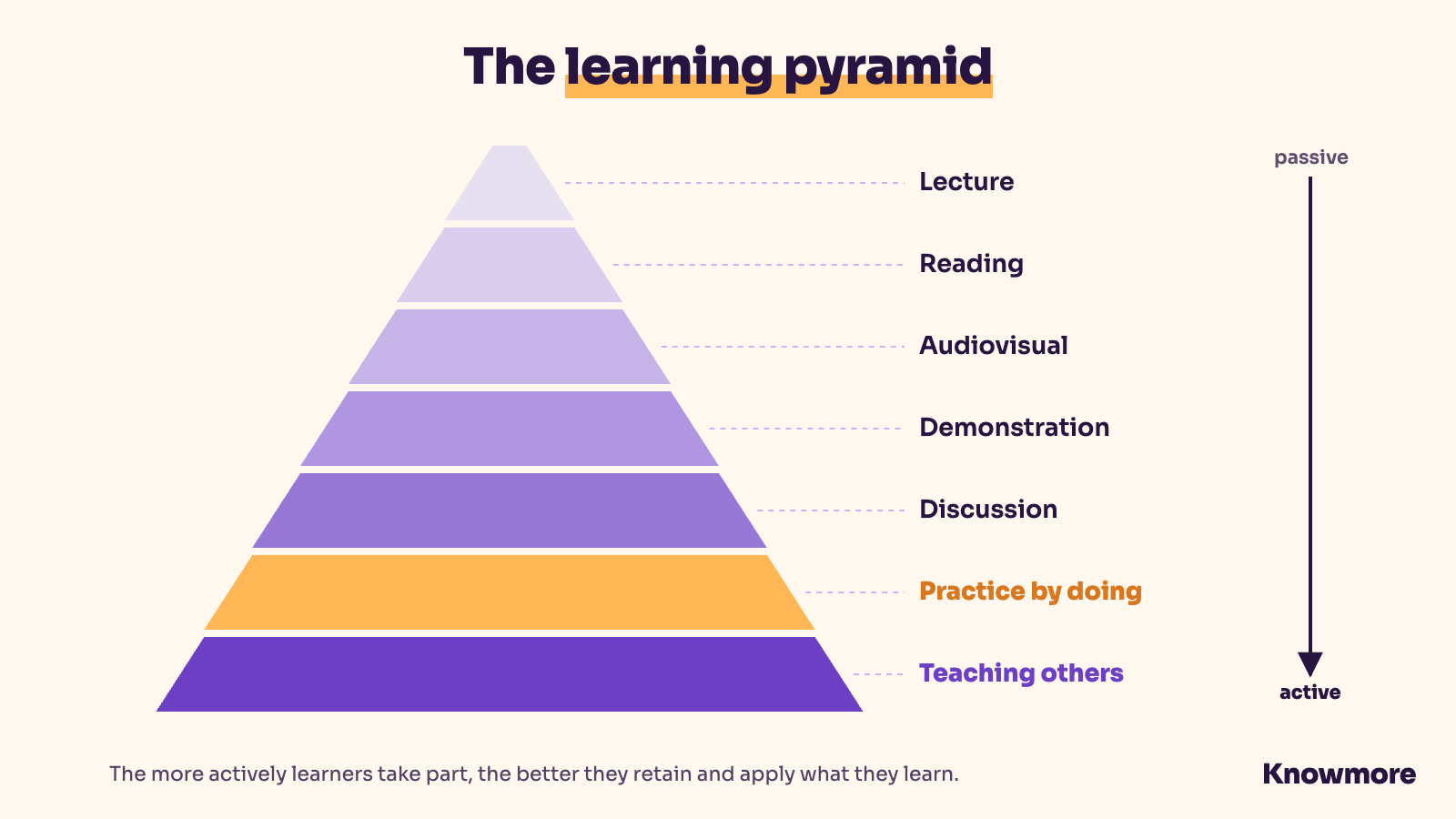
Better retention. Actively doing a task, with the decisions, errors and corrections it involves, engages learners far more than passively receiving information, and this engagement supports long-term memory. The "learning pyramid", inspired by Edgar Dale's "Cone of Experience" (1946), illustrates this idea: it ranks learning methods from the most passive (reading, listening to a lecture) to the most active (practising, teaching others), showing that the more involved learners are, the more they retain and can reuse.
Motivation and engagement. By becoming an active participant, the learner's intrinsic motivation increases. Unlike a standardised curriculum, learning by doing adapts to the learner's goals and pace, which strengthens their sense of purpose.
Adaptability and soft skills. By facing real problems, employees develop autonomy, problem-solving, creativity and communication skills. Above all, they gain confidence in their ability to learn new skills on their own, an essential asset at a time when jobs and tools constantly change. Consider a salesperson trained through learning by doing who moves to a different sector, such as sustainable mobility: thanks to their ability to learn independently, they quickly master the technical aspects of the new products and map the new network of stakeholders.
Cost efficiency. For employers, learning by doing offers economic advantages: training tailored to the job wastes less time; on-the-job learning keeps employees productive while they develop; and employees who feel supported in their development are more likely to stay.
Benefits and limits at a glance
| Benefits | Limits and how to address them |
|---|---|
| Skills directly applicable to the job | Takes longer than a lecture to cover theory: combine short theoretical inputs with practice. |
| Better engagement and retention | Practice alone can reinforce bad habits: build in reflection and feedback. |
| Learning at each person's pace | Requires supervision and mentors' time: use digital guidance to scale support. |
| Positive relationship with error | Mistakes in real systems can be costly or risky: practise first in a simulation or sandbox. |
| Autonomy, adaptability and soft skills | Needs careful design of tasks and objectives: start from a training needs analysis. |
| Learning embedded in daily work | Can require specific equipment, infrastructure or tools: choose solutions that integrate into existing applications. |
Learning by doing vs traditional training
Learning by doing does not replace every form of instruction: some theory is needed before practice makes sense. But for practical skills, the two approaches differ on several points.
| Criterion | Traditional (transmissive) training | Learning by doing |
|---|---|---|
| Role of the learner | Listens, reads, takes notes | Acts, tests, makes decisions |
| Role of the trainer | Delivers content | Designs tasks, coaches, gives feedback |
| Timing | Often weeks before the skill is needed | At or close to the moment of use |
| Place of mistakes | To be avoided, often sanctioned in assessments | Expected and used to learn |
| Pace | The same for the whole group | Adapted to each learner |
| Best suited to | Concepts, regulations, shared culture | Procedures, tools, practical and interpersonal skills |
In practice, the most effective programmes are blended: a short explanation of the "why", then practice, then reflection. For software, this often means a brief introduction, followed by guided tasks in the application and a debrief on common mistakes.
Examples of learning by doing in business software
Learning by doing is particularly well suited to the adoption of digital tools, because using software is a practical skill: nobody learns to use a CRM by reading a manual. Some concrete examples:
- CRM: a salesperson new to the CRM creates their first customer record with a step-by-step guide displayed in the application, while doing the real task. See also our 6 steps to a successful CRM implementation.
- ERP: a purchasing assistant practises entering a purchase order in a simulation that replicates the ERP screens, before doing it in the live system.
- HRIS: managers learn to approve leave requests or complete annual reviews through contextual tips that appear the first time they open each screen.
- Custom or in-house software: where no external training exists, guided paths built directly on the application replace documentation. See our use case on custom software adoption.
- Onboarding: new hires discover their tools through interactive tours and short practical exercises, as part of regular and continuous training.
How to implement learning by doing in your company
Step 1: identify learning objectives
Start with a training needs analysis: which skills need to be developed, for which roles, in which tools and processes? This defines where learning by doing brings the most value.
Step 2: design practical, relevant activities
Turn objectives into real tasks: case studies, simulations, guided exercises in the application, small projects. Tailored training based on real work situations is what makes learning by doing effective.
Step 3: train trainers and managers
Trainers and learning managers need to know how to design practical activities, guide learners, give feedback and lead reflection sessions. Their role shifts from delivering content to coaching.
Step 4: involve management
Management plays a key role in creating a culture of active learning: encouraging experimentation, accepting mistakes as part of learning, providing resources and recognising skills acquired through practice. This requires trust and transparency with teams.
Step 5: align with business goals and measure
Align the approach with the company's strategic and operational objectives, and track progress: completion of practical tasks, errors, support requests and actual use of the tools. This data helps adjust learning paths and demonstrate effectiveness.
Tools for learning by doing: DAP, simulations and e-learning
To establish a culture of learning through action, companies can rely on dedicated digital solutions.
Digital adoption platforms (DAP)
A digital adoption platform is a layer that sits on top of business applications and guides users as they work, through interactive step-by-step guides, contextual tips, messages, short videos and quizzes. Its approach is rooted in learning by doing: users learn while performing their real tasks, at the moment they need help. DAPs also track progress and highlight where users get stuck, so that training managers can adjust their programmes. They are valuable allies when deploying new tools or work methods.
At Knowmore, K-NOW is our digital adoption platform built on the principles of experiential learning. It guides users inside their business applications (HRIS, ERP, CRM, PLM, purchasing) with interactive guides and real-time assistance, so that teams become autonomous on new tools and procedures. Its reporting shows engagement and progress and identifies sticking points.
Simulations and e-learning
E-learning modules combine theory and practical exercises. Their great advantage for learning by doing is simulation: trainees can practise risky or costly procedures in a safe environment, and train at their own pace, including when working remotely, which reduces travel and in-person sessions.
K-STUDIO is our authoring tool for creating interactive training that simulates business applications. Employees practise in a replica of their daily tools without risk of error, work through realistic scenarios and exercises, and receive immediate feedback on their mistakes.
What it brings to the business
- Faster adoption of tools, which supports the return on IT investments.
- Lower training costs, with fewer in-person sessions and learning available inside the tools.
- Measurable effectiveness, thanks to usage and progress data.
- A better employee experience: learning in a familiar environment reduces stress and eases change.
By placing action at the heart of learning, learning by doing benefits both individuals and organisations. At Knowmore, we help companies in every industry upskill their employees on their business applications through learning by doing. Request a personalised demo to see how it works in your tools.
FAQ
What is the meaning of learning by doing?
Learning by doing means acquiring knowledge and skills by carrying out real tasks rather than by listening or reading. The learner practises, makes mistakes, reflects on the results and adjusts. It is also called experiential learning or learning through practice, and is used in schools, vocational training and workplace training, especially for practical skills such as using software.
What is John Dewey's theory of learning by doing?
John Dewey (1859-1952), an American philosopher and educator, argued that education should be rooted in experience rather than abstract instruction. In Democracy and Education (1916) and Experience and Education (1938), he advocated connecting learning to students' interests and real activities. For Dewey, experience becomes learning only when it is followed by reflection.
What is the learning by doing method?
The learning by doing method organises training around practical activities: real tasks, case studies, simulations or projects. The learner acts first, then reflects on the experience with feedback from a trainer or tool, and tries again. Its key principles are active participation, the right to make mistakes, reflection, tailored support and challenges adapted to the learner's level.
What is it called when you learn by doing?
Learning by doing is also called experiential learning, hands-on learning, active learning or learning through practice. In the workplace, related terms include on-the-job training and learning in the flow of work. David Kolb's experiential learning theory (1984) is one of the best-known models of this approach.
Why is learning by doing important?
Learning by doing matters because it develops skills that are directly usable, keeps learners engaged and builds confidence and adaptability. In companies, it helps employees become productive faster on new tools and processes, and integrates training into daily work. It is most effective when practice is combined with reflection and feedback.
What are examples of learning by doing at work?
Examples include a salesperson creating their first customer record in a new CRM with in-app guidance, an employee practising an ERP purchase order in a simulation, a manager learning HRIS approvals through contextual tips, apprenticeships, job shadowing followed by practice, and project-based learning where teams solve a real business problem.